
work
Eh balla!
| category | Graphics |
| subject | Human figure |
| tags | memoria, Grotta dei cervi, Antropomorfo, Badisco, metallo, viaggio, anima, ancestrale |
| base | 100 cm |
| height | 40 cm |
| depth | 0 cm |
| year | 2002 |
Mixed media on galvanized metal sheet
Dimensions: 100 x 0.3 x 40 cm
Year: 2002
Description of metal works and ancestral symbols:
The idea of using a metal sheet stems from the desire to evoke the memory of a letter, a message written on a thin sheet of paper, which, in its journey through distant lands, has become a witness to joys and sorrows over the centuries.
The use of a cold and amorphous material like metal emphasizes the image of a forgotten letter, replaced by modern technology. Writing represents the seed of memory, which travels like lines on a sheet of paper: memories fixed in time, crystallized, and finally frozen in oblivion, as society pursues new means of communication.
The metal, with its ferrous coldness, thus becomes the symbol of the slow and perpetual death of the letter, transformed into a tombstone.
Conceptually, the metal sheet becomes a mirror of our soul: we cannot reflect ourselves because it is difficult for us to distinguish our identity, our deepest self.
When flashes of memory resurface, the memories materialize in primordial signs and images that emerge on the cold surface of the metal, affirming the will to recognize ourselves.
At this point, the metal "sheets" become materialized letters from the past, marked with a stamp and the seal of the envelope: messages sent to humanity, without a specific recipient, even sent back to the sender.
The images, reproduced with metal dust and rust, recompose into figures that tell a story.
The artistic journey in the works follows a common thread of memory through a search for elementary, primordial images, the starting point of the writing, to tell a fantastical journey between will and reality, to discover our roots.
The images in the two works are taken from over three thousand pictograms, made with bat guano and recovered from the Grotta dei Cervi in Porto Badisco (Lecce), a site of great interest for UNESCO and not accessible to the public. They represent the earliest forms of writing: messages, or rather "concept maps," dating back to 3900 BC, the oldest in Europe.
A language of natural, anthropomorphic, abstract, and zoomorphic symbols, traced by men who wrote their desires on the rock: men who wanted to leave a message, to send letters of amorphous matter to us.
Drawings and writings that danced in a ritual poetry, which has survived intact to the present day, translated over time onto sheets of paper, then enclosed, encapsulated by technological evolution, in metal casings.
And yet, the beating heart of the sign is still alive: it continues to tell our story, our true identity, which refuses to die.
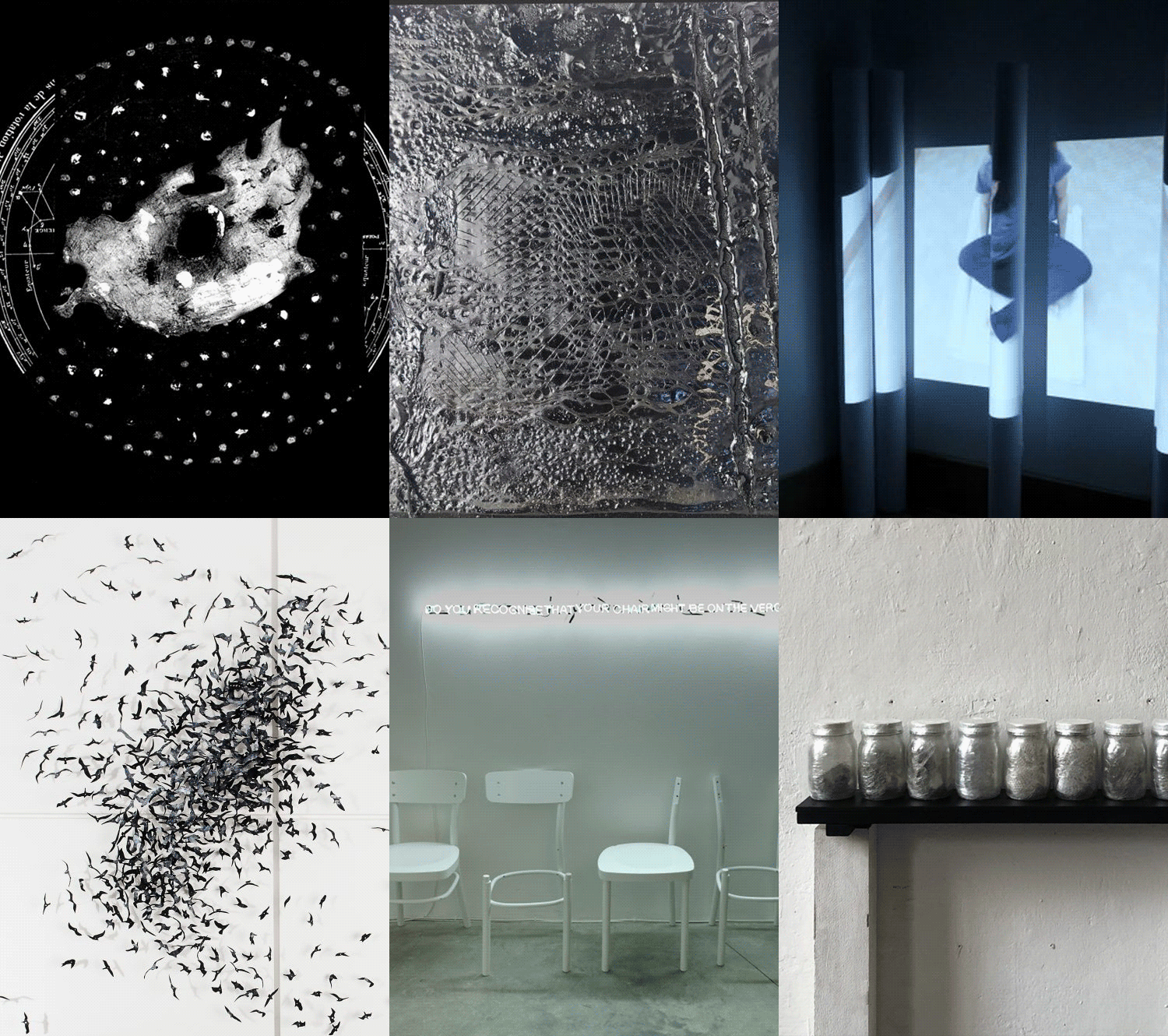
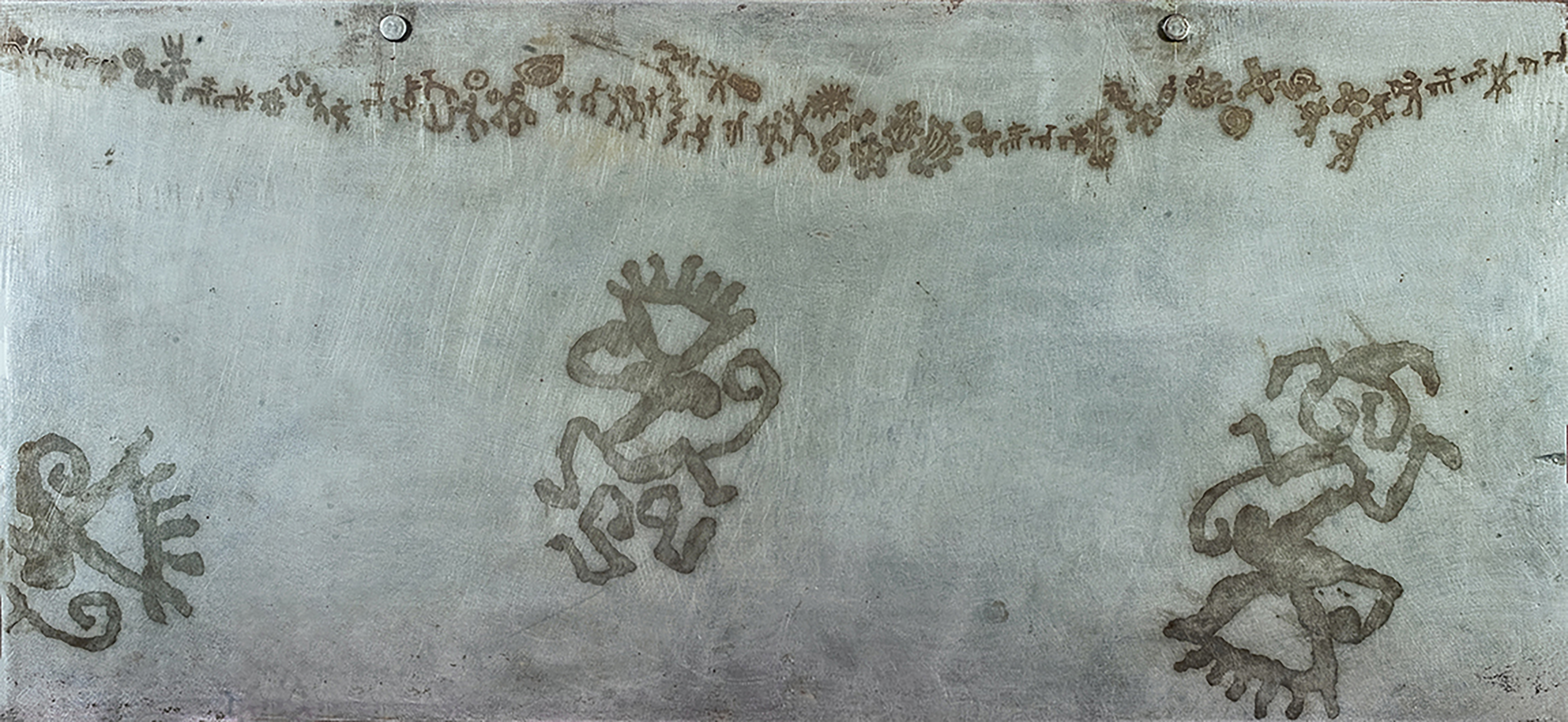
This seemingly cold and industrial metal sheet transforms into an ancestral archive, a palimpsest of time engraved with archaic signs and dancing figures. The engraved traces are not simple decorations: they are fossilized memories, survivals of forgotten gestures and languages that resurface on the surface like echoes of a distant past.
The upper line of the sheet, occupied by a sequence of cryptic symbols, recalls the idea of an original script, a pre-alphabetic language that seems suspended between communication and ritual. Here, memory is neither linear nor rational, but corporeal, tribal, mythical. It is a time that does not flow but returns, repeating itself like a song or a sacred dance.
The three anthropomorphic figures engraved at the bottom appear as beings in motion—perhaps dancing, perhaps fighting, perhaps celebrating. Their contorted and symbolic bodies seem to evoke an ancestral energy: the memory of the body, of celebration, of ritual. They are timeless figures, outside of history and narrative, icons of a primitive yet eternal humanity, spanning the ages with the same urgency to exist and leave a mark.
The use of metal, a material resistant to the corrosion of time, accentuates the contrast between the fragility of memory and the permanence of the medium. It is as if the artist wanted to crystallize a moment, make it eternal, while knowing that every memory is selective, imperfect, and destined to change. The metal becomes a skin, a medium that records the traces of what was, without interpreting it, like a carefully engraved fossil.
The title, "Eh balla," introduces an ironic and poetic tension. It brings us back to the present, to everyday language, but at the same time underscores the vitality of the gesture. It is an invitation to move within time, to dance with memory, not just preserve it. Dance here is not just an aesthetic act, but a form of resistance to time, a way of remembering through the body, rhythm, and movement.
This work speaks not only of the past, but of the contemporary urgency of not forgetting. It is a reflection on memory as an active act, on time as a space.
Dimensions: 100 x 0.3 x 40 cm
Year: 2002
Description of metal works and ancestral symbols:
The idea of using a metal sheet stems from the desire to evoke the memory of a letter, a message written on a thin sheet of paper, which, in its journey through distant lands, has become a witness to joys and sorrows over the centuries.
The use of a cold and amorphous material like metal emphasizes the image of a forgotten letter, replaced by modern technology. Writing represents the seed of memory, which travels like lines on a sheet of paper: memories fixed in time, crystallized, and finally frozen in oblivion, as society pursues new means of communication.
The metal, with its ferrous coldness, thus becomes the symbol of the slow and perpetual death of the letter, transformed into a tombstone.
Conceptually, the metal sheet becomes a mirror of our soul: we cannot reflect ourselves because it is difficult for us to distinguish our identity, our deepest self.
When flashes of memory resurface, the memories materialize in primordial signs and images that emerge on the cold surface of the metal, affirming the will to recognize ourselves.
At this point, the metal "sheets" become materialized letters from the past, marked with a stamp and the seal of the envelope: messages sent to humanity, without a specific recipient, even sent back to the sender.
The images, reproduced with metal dust and rust, recompose into figures that tell a story.
The artistic journey in the works follows a common thread of memory through a search for elementary, primordial images, the starting point of the writing, to tell a fantastical journey between will and reality, to discover our roots.
The images in the two works are taken from over three thousand pictograms, made with bat guano and recovered from the Grotta dei Cervi in Porto Badisco (Lecce), a site of great interest for UNESCO and not accessible to the public. They represent the earliest forms of writing: messages, or rather "concept maps," dating back to 3900 BC, the oldest in Europe.
A language of natural, anthropomorphic, abstract, and zoomorphic symbols, traced by men who wrote their desires on the rock: men who wanted to leave a message, to send letters of amorphous matter to us.
Drawings and writings that danced in a ritual poetry, which has survived intact to the present day, translated over time onto sheets of paper, then enclosed, encapsulated by technological evolution, in metal casings.
And yet, the beating heart of the sign is still alive: it continues to tell our story, our true identity, which refuses to die.
This seemingly cold and industrial metal sheet transforms into an ancestral archive, a palimpsest of time engraved with archaic signs and dancing figures. The engraved traces are not simple decorations: they are fossilized memories, survivals of forgotten gestures and languages that resurface on the surface like echoes of a distant past.
The upper line of the sheet, occupied by a sequence of cryptic symbols, recalls the idea of an original script, a pre-alphabetic language that seems suspended between communication and ritual. Here, memory is neither linear nor rational, but corporeal, tribal, mythical. It is a time that does not flow but returns, repeating itself like a song or a sacred dance.
The three anthropomorphic figures engraved at the bottom appear as beings in motion—perhaps dancing, perhaps fighting, perhaps celebrating. Their contorted and symbolic bodies seem to evoke an ancestral energy: the memory of the body, of celebration, of ritual. They are timeless figures, outside of history and narrative, icons of a primitive yet eternal humanity, spanning the ages with the same urgency to exist and leave a mark.
The use of metal, a material resistant to the corrosion of time, accentuates the contrast between the fragility of memory and the permanence of the medium. It is as if the artist wanted to crystallize a moment, make it eternal, while knowing that every memory is selective, imperfect, and destined to change. The metal becomes a skin, a medium that records the traces of what was, without interpreting it, like a carefully engraved fossil.
The title, "Eh balla," introduces an ironic and poetic tension. It brings us back to the present, to everyday language, but at the same time underscores the vitality of the gesture. It is an invitation to move within time, to dance with memory, not just preserve it. Dance here is not just an aesthetic act, but a form of resistance to time, a way of remembering through the body, rhythm, and movement.
This work speaks not only of the past, but of the contemporary urgency of not forgetting. It is a reflection on memory as an active act, on time as a space.