

work
Abisso stratificato
| category | Painting |
| subject | Nature, Abstract |
| tags | rifiuto, natura, organico, inorganico, olastica, ambiente, inquinamneto, società, scarto, alimenti |
| base | 60 cm |
| height | 40 cm |
| depth | 0 cm |
| year | 2022 |
Title: Stratified Abyss
Size: 70x50x0.3
Substrate: Print on Forex
Technique: Mixed media on micro-paintings of organic and inorganic fragments, acrylic, and glue, fixed on acetate rectangles mounted on 24x36 mm slide frames and subsequently post-digitized without using AI in the digital process.
Year: 2022
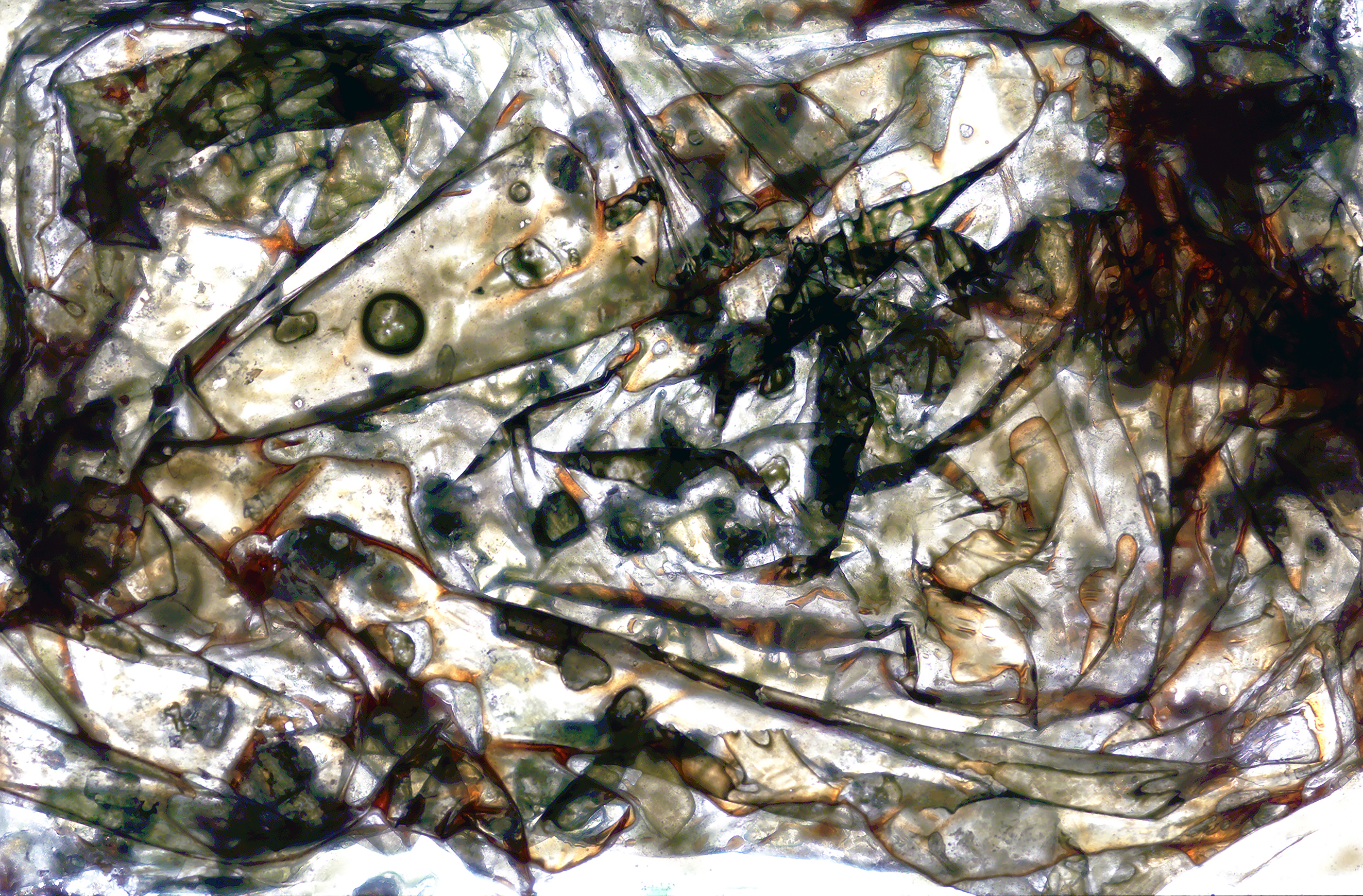
Stratified Abyss is a micro-painting that transforms the seabed into an interior geography, a territory suspended between organism and matter, between memory and transformation. The work arises from a hybrid and radically experimental process: post-production interventions on acetate slides, constructed with plastics, pigments, and organic and inorganic materials, subsequently digitized without the aid of artificial intelligence. This technical element is not marginal, but an integral part of the poetics of the work: each fragment is the result of a physical, manual action, of a slow sedimentation time.
From this process emerge organic and inorganic microfragments, fixed on acetate rectangles mounted on 24x36 mm slide frames. Using natural dyes and glues, these residues are enhanced and transformed into visual material. The work focuses on the meaning of waste: what is considered waste does not disappear, but persists, transforms, and leaves traces. From this perspective, waste is not just an environmental fact, but a cultural condition that irreversibly alters the landscape.
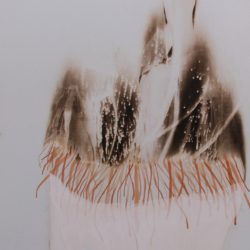
The surface presents itself as a complex sedimentation: translucent layers overlap, generating tensions between opacity and transparency. The colors—oxidized greens, ferrous browns, milky whites—evoke an underwater ecosystem where light and matter compete for space. The jagged shapes recall algae, coral remains, organic membranes, and plastic debris, suggesting an environment both natural and anthropized. There is no defined focal point: the gaze is forced into a slow, almost tactile exploration, as if immersed in a murky, contemporary abyss.
Compositionally, diagonal lines and broken fractures generate a continuous internal movement. The seabed is not still, but tense: a living and fragile ecosystem, crisscrossed by lacerations that recall both geological processes and human impact. Plastic, physically incorporated into the creative process, becomes symbol and testimony: what in reality pollutes the sea is here transfigured into visual language, taking on a critical and reflective value.
The intimate scale of micropainting amplifies the sense of immersion. The reduced dimension requires a close, almost microscopic gaze, reversing the perception of the landscape: the infinitely small becomes vast, the marginal element becomes the universe. Digitalization does not alter the material nature of the work, but extends its enjoyment, making every detail, every ripple, every inclusion perceptible.
Abisso Stratificato thus takes the form of a symbolic map of the contemporary sea: not a mimetic representation, but a critical stratification that questions the relationship between nature and artifice, between biological memory and industrial waste. It is a work that demands time, attention, and responsibility, inviting the viewer to traverse a seabed where beauty and restlessness, fragility and resistance coexist.
Elisabetta Accoto
Size: 70x50x0.3
Substrate: Print on Forex
Technique: Mixed media on micro-paintings of organic and inorganic fragments, acrylic, and glue, fixed on acetate rectangles mounted on 24x36 mm slide frames and subsequently post-digitized without using AI in the digital process.
Year: 2022
Stratified Abyss is a micro-painting that transforms the seabed into an interior geography, a territory suspended between organism and matter, between memory and transformation. The work arises from a hybrid and radically experimental process: post-production interventions on acetate slides, constructed with plastics, pigments, and organic and inorganic materials, subsequently digitized without the aid of artificial intelligence. This technical element is not marginal, but an integral part of the poetics of the work: each fragment is the result of a physical, manual action, of a slow sedimentation time.
From this process emerge organic and inorganic microfragments, fixed on acetate rectangles mounted on 24x36 mm slide frames. Using natural dyes and glues, these residues are enhanced and transformed into visual material. The work focuses on the meaning of waste: what is considered waste does not disappear, but persists, transforms, and leaves traces. From this perspective, waste is not just an environmental fact, but a cultural condition that irreversibly alters the landscape.
The surface presents itself as a complex sedimentation: translucent layers overlap, generating tensions between opacity and transparency. The colors—oxidized greens, ferrous browns, milky whites—evoke an underwater ecosystem where light and matter compete for space. The jagged shapes recall algae, coral remains, organic membranes, and plastic debris, suggesting an environment both natural and anthropized. There is no defined focal point: the gaze is forced into a slow, almost tactile exploration, as if immersed in a murky, contemporary abyss.
Compositionally, diagonal lines and broken fractures generate a continuous internal movement. The seabed is not still, but tense: a living and fragile ecosystem, crisscrossed by lacerations that recall both geological processes and human impact. Plastic, physically incorporated into the creative process, becomes symbol and testimony: what in reality pollutes the sea is here transfigured into visual language, taking on a critical and reflective value.
The intimate scale of micropainting amplifies the sense of immersion. The reduced dimension requires a close, almost microscopic gaze, reversing the perception of the landscape: the infinitely small becomes vast, the marginal element becomes the universe. Digitalization does not alter the material nature of the work, but extends its enjoyment, making every detail, every ripple, every inclusion perceptible.
Abisso Stratificato thus takes the form of a symbolic map of the contemporary sea: not a mimetic representation, but a critical stratification that questions the relationship between nature and artifice, between biological memory and industrial waste. It is a work that demands time, attention, and responsibility, inviting the viewer to traverse a seabed where beauty and restlessness, fragility and resistance coexist.
Elisabetta Accoto