

work
Il viaggio di Irene: La pace come frammento ricomposto
| category | Sculpture |
| subject | Human figure |
| tags | Irene, pace, guerra, ali, vita |
| base | 50 cm |
| height | 50 cm |
| depth | 30 cm |
| year | 2016 |
Title: "Irene's Journey: Peace as a Recomposed Fragment"
Author: Elisabetta Accoto
Year of Creation: 2016
Technique: Mixed Sculpture and Mosaic
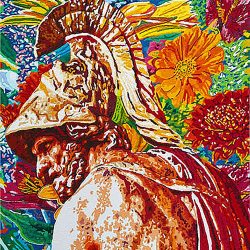
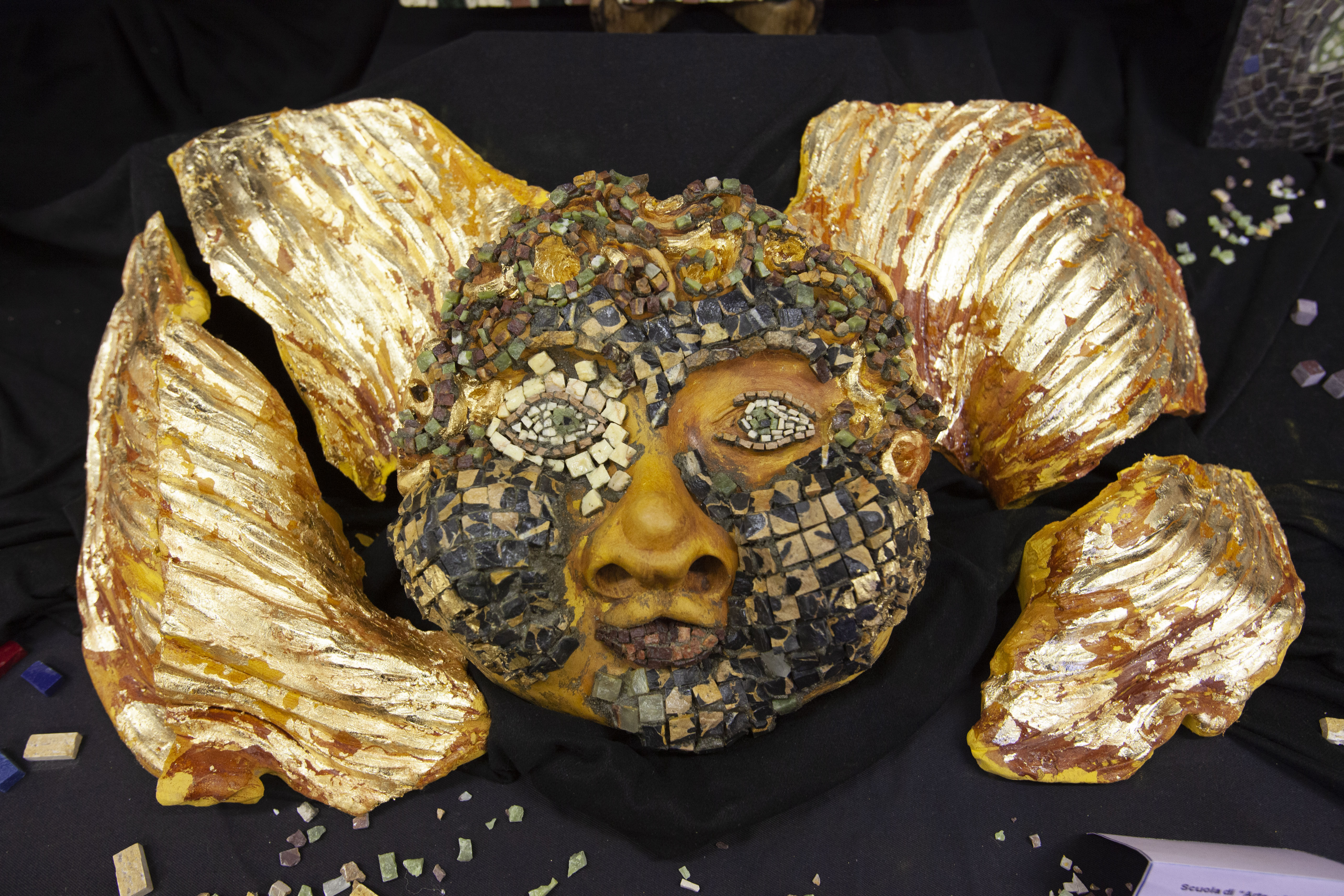
This work, constructed from a variety of materials—mosaic, stone, terracotta, and gold—depicts a human face with solemn features and intense expressions, framed by four large, fragmented golden wings. It is a face that seems to emerge from time, a universal symbol uniting earth and light, the sacred and the human. Through this figure, we can understand the long journey of peace, personified by the Greek goddess Eirēnē (Irene), from antiquity to the present day: a journey through the centuries, civilizations, and the metamorphoses of the human soul.
In ancient Greece, Irene was the goddess of harmony and concord, daughter of Zeus and Themis, divine law. Her image represented the balance between heaven and the polis, between destiny and human will. In the mosaic face of the work, Irene seems reborn from those origins: each tile, different in shape and color, evokes the idea of the polis, where peace is born from the dialogue between differences. The gold surrounding the face evokes the Olympian light, a sign of order and measure, while the fractures and irregularities introduce an element of tension, a reminder that harmony is fragile, continually to be conquered.
All around, the large, broken golden wings, luminous and scarred by war, are not just ornamentation: they represent the tension between fragility and hope. Their worn gold reflects the light that survives time, a glow that speaks of rebirth.
They also evoke the goddess Nike, the Victory of Samothrace, a symbol of impetus and freedom. Like the goddess's wings, these represent the strength of movement and spiritual elevation: they are the desire of the human soul to free itself from the burden of matter, to overcome destruction and be reborn in the light. The wings thus become an emblem of freedom achieved, of an inner victory that accompanies the path to peace.
Today, Irene is still among us, but her face has changed. It is that of the work itself: human, imperfect, multifaceted. The broken tiles are the scars of history, but also the signs of its capacity for rebirth. Irene, the ancient goddess, no longer speaks only to people, but to the individual, called to rebuild himself and the world after destruction. The wings, though shining, appear heavy: it is the weight of the responsibility that weighs on each generation to preserve peace as a collective value.
Her tiles are no longer symbols of order, but fragments of different identities coexisting in the same space. The gold continues to shine, but now represents the inner light of a humanity aware of its own fragility. Peace is no longer a divine gift but a daily process, made of dialogue, memory, and reconstruction.
Irene's journey, which began in ancient Greece, thus unfolds in the present as a reflection on the human condition. The mosaic face, with its imperfections and broken beauty, bears witness to a peace that endures over time, transforming with and within humanity. The golden wings represent the possibility of soaring, but also the effort of flight; gold and earth coexist as symbols of spirit and matter, of the divine and the human.
I think of the work in this place where the solemn silence of forms and memories reigns, the plaster cast gallery. But precisely in that silence, this figure seeks to "make noise": the noise of humanity still seeking peace, of thoughts stirring, of the heart resisting. It is an echo of life within a space of quiet, an invitation not to remain silent in the face of history.
In this work, peace is not a destination, but a journey: Irene's journey through the centuries, from the sacredness of the Olympic Games to the complex and fragile world of today. It is the journey of humanity itself, which, despite contradictions and fractures, continues to seek its own harmony, building with its own hands a new face of peace, a face that resembles us, and that continues to look toward the light.
Today, Irene no longer walks among the temples of Greece, but among our cities, within the restless silence of the world. She is a presence that questions us: how much peace are we willing to preserve, how much memory to pass on. Her face, reborn from fragments, becomes a mirror of our time, a time in which peace is not a gift from the gods, but a fragile, daily choice of man.
In her gaze, the voices of peoples intertwine, the hopes of migrants, the hushed song of cultures still seeking a place of encounter. Irene continues her journey, no longer as a myth, but as a living commitment: the peace that is reborn every time someone chooses to listen, to understand, to recompose.
Perhaps peace is not an eternal gift, but a fragile mosaic that each generation must learn to reassemble. Irene is no longer a myth: she is our gaze when we choose not to have enemies.
Author: Elisabetta Accoto
Year of Creation: 2016
Technique: Mixed Sculpture and Mosaic
This work, constructed from a variety of materials—mosaic, stone, terracotta, and gold—depicts a human face with solemn features and intense expressions, framed by four large, fragmented golden wings. It is a face that seems to emerge from time, a universal symbol uniting earth and light, the sacred and the human. Through this figure, we can understand the long journey of peace, personified by the Greek goddess Eirēnē (Irene), from antiquity to the present day: a journey through the centuries, civilizations, and the metamorphoses of the human soul.
In ancient Greece, Irene was the goddess of harmony and concord, daughter of Zeus and Themis, divine law. Her image represented the balance between heaven and the polis, between destiny and human will. In the mosaic face of the work, Irene seems reborn from those origins: each tile, different in shape and color, evokes the idea of the polis, where peace is born from the dialogue between differences. The gold surrounding the face evokes the Olympian light, a sign of order and measure, while the fractures and irregularities introduce an element of tension, a reminder that harmony is fragile, continually to be conquered.
All around, the large, broken golden wings, luminous and scarred by war, are not just ornamentation: they represent the tension between fragility and hope. Their worn gold reflects the light that survives time, a glow that speaks of rebirth.
They also evoke the goddess Nike, the Victory of Samothrace, a symbol of impetus and freedom. Like the goddess's wings, these represent the strength of movement and spiritual elevation: they are the desire of the human soul to free itself from the burden of matter, to overcome destruction and be reborn in the light. The wings thus become an emblem of freedom achieved, of an inner victory that accompanies the path to peace.
Today, Irene is still among us, but her face has changed. It is that of the work itself: human, imperfect, multifaceted. The broken tiles are the scars of history, but also the signs of its capacity for rebirth. Irene, the ancient goddess, no longer speaks only to people, but to the individual, called to rebuild himself and the world after destruction. The wings, though shining, appear heavy: it is the weight of the responsibility that weighs on each generation to preserve peace as a collective value.
Her tiles are no longer symbols of order, but fragments of different identities coexisting in the same space. The gold continues to shine, but now represents the inner light of a humanity aware of its own fragility. Peace is no longer a divine gift but a daily process, made of dialogue, memory, and reconstruction.
Irene's journey, which began in ancient Greece, thus unfolds in the present as a reflection on the human condition. The mosaic face, with its imperfections and broken beauty, bears witness to a peace that endures over time, transforming with and within humanity. The golden wings represent the possibility of soaring, but also the effort of flight; gold and earth coexist as symbols of spirit and matter, of the divine and the human.
I think of the work in this place where the solemn silence of forms and memories reigns, the plaster cast gallery. But precisely in that silence, this figure seeks to "make noise": the noise of humanity still seeking peace, of thoughts stirring, of the heart resisting. It is an echo of life within a space of quiet, an invitation not to remain silent in the face of history.
In this work, peace is not a destination, but a journey: Irene's journey through the centuries, from the sacredness of the Olympic Games to the complex and fragile world of today. It is the journey of humanity itself, which, despite contradictions and fractures, continues to seek its own harmony, building with its own hands a new face of peace, a face that resembles us, and that continues to look toward the light.
Today, Irene no longer walks among the temples of Greece, but among our cities, within the restless silence of the world. She is a presence that questions us: how much peace are we willing to preserve, how much memory to pass on. Her face, reborn from fragments, becomes a mirror of our time, a time in which peace is not a gift from the gods, but a fragile, daily choice of man.
In her gaze, the voices of peoples intertwine, the hopes of migrants, the hushed song of cultures still seeking a place of encounter. Irene continues her journey, no longer as a myth, but as a living commitment: the peace that is reborn every time someone chooses to listen, to understand, to recompose.
Perhaps peace is not an eternal gift, but a fragile mosaic that each generation must learn to reassemble. Irene is no longer a myth: she is our gaze when we choose not to have enemies.