

work
Porcellum
| category | Sculpture |
| subject | Political / Social |
| tags | Scultura contemporanea, Simbolismo, Identità nazionale, Grottesco, Critica sociale, Satira, Scultura figurativa, Legno, Pittura a olio, Terracotta, Ceramica, Scultura, Punk Art, Pezzo unico, Luke Sodano |
| base | 18 cm |
| height | 28 cm |
| depth | 9 cm |
| year | 2024 |
Hand-modeled and hand-painted oil on ceramic, finished with ceramic glaze. Gilded wooden cross. Unique piece (1/1).
Description:
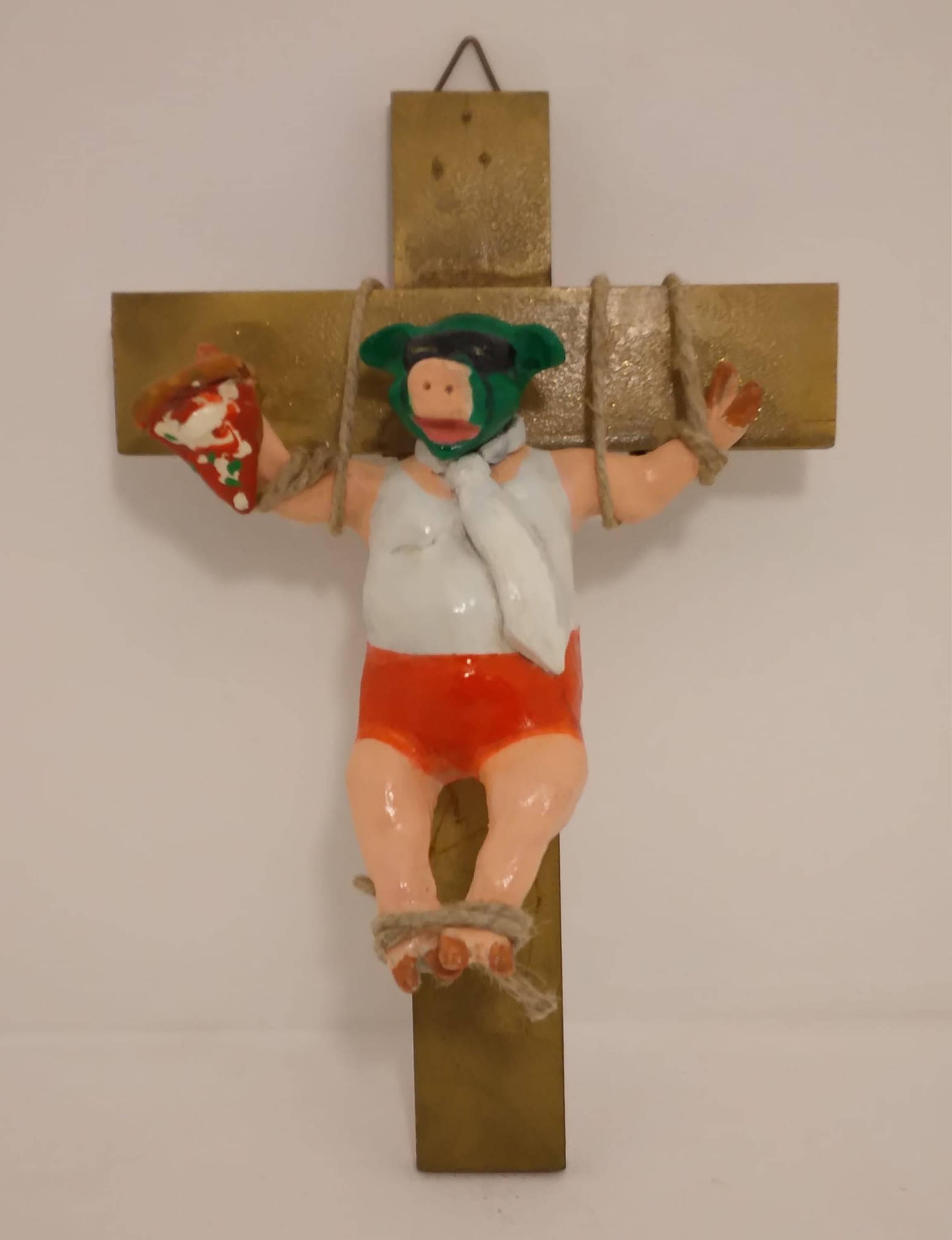
Porcellum is a sculpture that fuses the tradition of glazed ceramics with a contemporary grotesque narrative.
The zoomorphic figure, vividly painted in oils, is fixed to a gilded cross; the juxtaposition of refined ceramic technique and the cold gilding of the cross emphasizes the contrast between the aspiration towards the sacred and the artificial nature of contemporary reality. The work explores the martyrdom of the 'social pig,' a victim of compulsive consumption that becomes the only remaining ritual in a society hollowed of spirituality. By incorporating the colors of the Italian flag, the subject is transformed into a grotesque incarnation of the nation itself.
The title Porcellum explicitly references the lexicon of Italian political satire, elevating the work into a metaphor for a degraded system, victim of its own compulsive consumption.
Description:
Porcellum is a sculpture that fuses the tradition of glazed ceramics with a contemporary grotesque narrative.
The zoomorphic figure, vividly painted in oils, is fixed to a gilded cross; the juxtaposition of refined ceramic technique and the cold gilding of the cross emphasizes the contrast between the aspiration towards the sacred and the artificial nature of contemporary reality. The work explores the martyrdom of the 'social pig,' a victim of compulsive consumption that becomes the only remaining ritual in a society hollowed of spirituality. By incorporating the colors of the Italian flag, the subject is transformed into a grotesque incarnation of the nation itself.
The title Porcellum explicitly references the lexicon of Italian political satire, elevating the work into a metaphor for a degraded system, victim of its own compulsive consumption.