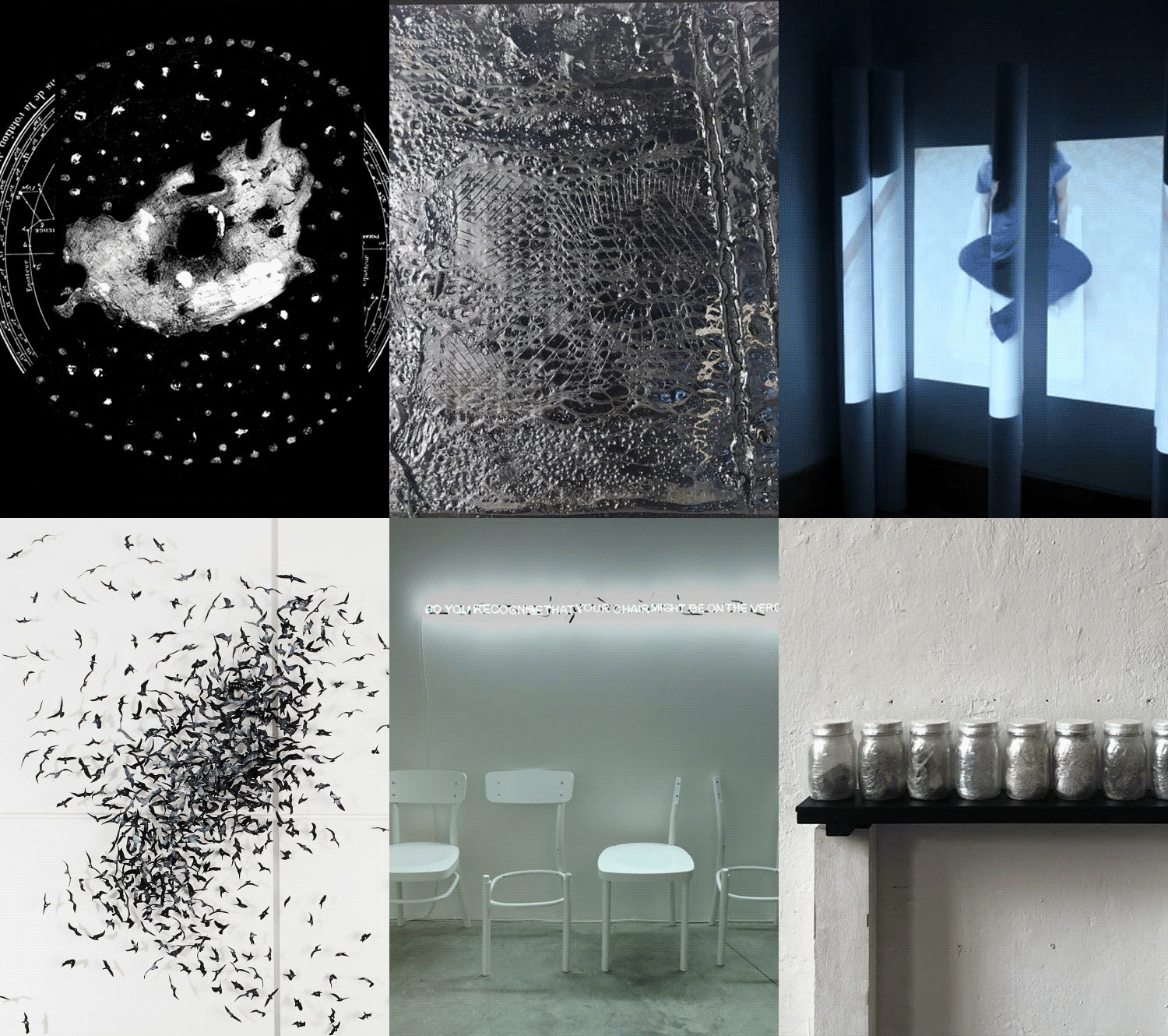

Valentina Gelain is the winner of the fifth edition of the exibart prize
In second place we find new entry Antonella Zito, while Xinhan Yú confirms third place.
The 10 finalists deserve credit for combining a high-quality artistic project with a solid and sustained presence in the art world, proving that the profession of art requires perseverance, professionalism, and strategy.
The jury, which had 605 points to allocate, struggled again this year to converge on just a few names, resulting in a very tight ranking where the difference between first and last place is only 14 points, with a maximum gap of 4 points between any two positions. This means that the exceptionally high quality of the entire group of finalists made it difficult to single out just a few names.
Among the observations to be made, we can note that out of the ten ranked artists, as many as 5 were already present on last edition’s shortlist. In fact, on the podium we see Gelain confirming her position by rising from last year’s second place to victory, and Yú reconfirming last year’s third place. The only surprise is the arrival in second place of new entry Antonella Zito, who immediately convinced a contest that increasingly proves it wants to reward the overall artistic journey rather than just the medium. All contemporary media are represented, with an interesting resurgence of painting.
Below is the ranking of the top 10 finalists:
- Valentina Gelain
- Antonella Zito
- Xinhan Yú
- Fabrice Bernasconi Borzì
- Tina Sgrò
- Plurale
- Samuel di Blasi
- Luciano Sozio
- Stefano Cescon
- Jacopo Dimastrogiovanni

Valentina Gelain
Valentina Gelain was born in Feltre in 1992 and currently lives and works in Ostrobothnia, Finland.
Through subjective experience and introspection, Gelain investigates issues related to human existentialism, drawing directly from the mental and emotional, symbolic and dreamlike spheres.
Thanks to a plural opening of perceptions, various research themes are explored—such as inner conflicts, mental landscapes, and redemption—through a synergy between form and content, image and intention.
Her analysis is based on the practice of (intra-)confrontation, openness, and dialogue, seeking to overturn barriers, reach out to, and touch the other through intimate reflections and genuine experiences. This gives space to invisible parts of our being that are often still rejected with indifference and misunderstanding, recalling unfettered resources of thought and awareness of the other starting from ourselves.
Stretching a thread between consciousness and unconsciousness, vision and figuration, the balance swings between introspective investigation and the search for an empathetic equilibrium. Accepting discomfort for true change in a voluntary, active path leads to various catharses of being and, consequently, to how we can (co-)exist in reality.
An interdisciplinary artist, Gelain explores subjects and figurations through different languages and media that help convey her vision of the artwork at its best.

Antonella Zito
I am Antonella Zito, I am 36 years old, originally from Apulia, and I live in Breda, the Netherlands. I am a graphic designer, photographer, and video maker. My artistic themes are inspired by psychology and everything that originates from the individual to contextualize them within society and the environment. My photographs belong to the “Staged Photography” genre, in which, through attention to the smallest detail, I recreate lived situations, environments, and characters described with an introspective approach flipped outwards. In video art, I apply the same principles as in photography, where the real and surreal often merge. My works have been exhibited and screened in galleries, foundations, museums, and festivals across Italy and Europe.

Xinhan Yú
Xinhan Yú (Nanjing, China, 1996)
Earned a Master’s degree in Visual Arts Painting from the two-year specialization program at the Academy of Fine Arts in Bologna in 2022. He currently resides in Bologna.
In Yú’s interventions, there is always a taste for spectacle, humor, and the grotesque, and his provocations resonate with Chinese youth; he conceals irony and metaphors within his imaginary narrative, playfully yet rawly flirting with the issues of new-era Chinese society. The desire for revenge, the need to act, and the ambition to circumvent an oppressive system are the motivations behind the works of XinHan Yú, a Chinese artist who uses various media as tools for social critique—a way to exhume a memory, both personal and collective, of a reality that needs to be brought to light. His current practice revolves around power structures and institutions of violence.

Fabrice Bernasconi Borzì
Fabrice Bernasconi Borzì is an Italian-Swiss artist born in Geneva in 1989. Since 2018, he lives and works in Catania.
For the artist, this relocation represents a sort of reverse journey compared to the one taken by many of his peers: in moving from Northern to Southern Europe, he attempts to rediscover a cultural alterity peculiar to places of origin, functional to his artistic practice. This national and existential dualism, this double citizenship, with its inherent contradiction, lies at the foundation of the balanced conflict between forces that his work aims to express.
The formal elements he employs are most often simple, minimal, or depotentiated, as if to subvert the ‘accustomed’ through the use of a paradoxical and at times provocative language of Dadaist origin, which does not shy away from citationism and recycling. The intent is clear, as it develops a series of questions on the very meaning of ‘making’, on its implicit conceptual assumptions, as well as on how all this is interpreted within the current art system. From these premises stems a reflection on human beings and their alienation from existence, in a dichotomy that politically inherits the tradition of conflict between productive and social forces, against hegemonic and capitalist powers.

Tina Sgrò
Tina Sgrò was born in 1972 in Reggio Calabria, where she completed her education and training. Her artistic inclinations emerged in early childhood. She attended the State Art Institute of Reggio Calabria, beginning an artistic/emotional journey that would prove fundamental to her life as a woman and artist.
She later earned a Degree in Painting at an Italian Academy of Fine Arts with top honors (110/110 cum laude) and embarked on her artistic career by participating in prestigious painting competitions and numerous group exhibitions.

plurale
plurale is a collective form of presence in the world that manifests as an open ensemble. From June 2020 to March 2022, it exhibited under the name Collettivo Plurale, after which it no longer felt the need to present itself as an author with a first and last name, because plurale, before being an artistic collective, is a reaction, a way of thinking, and thus a way of acting. plurale stems from the need to feel part of the same environment-being; for this reason, it looks where division exists and attempts to mend it.
plurale is a concept.
Founded in 2020, it presents itself as an osmotic artistic collective whose core motivators are Leonardo Avesani (Verona, 1997) and Chiara Ventura (Verona, 1997). By exploring an empathetic form of existence through artistic practice, plurale works on the flaws it finds in everyday life, paying special attention to language, forms of violence, and how the generation to which its members belong (Generation Z) positions itself in the world.
In 2022, it published Gesto empatico (Empathetic Gesture), a poetic declaration asserting its being-in-the-world, advocating empathetic action as the only viable mean today to restore equal rights and dignity to beings and things. plurale has initiated a transfeminist practice in an attempt to dismantle a heteronormative view of the body and decolonize desire, observing sexuality and pleasure as political spaces.

Samuel Di Blasi
Samuel Di Blasi is an Italian artist born in Alba in 1975.
He trained at the School of Sculpture under Riccardo Cordero at the Academy of Fine Arts in Turin, and in 1999 in London, he refined his artistic language in the studio of Japanese sculptor Noriaki Maeda.
In 2015, he presented “Lo Scalatore di Nuvole” (The Cloud Climber), a solo exhibition at the Museo Nazionale della Montagna in Turin;
in 2016, he won the National Art Award “Ora”, and in 2018 he created “Sognando Sogni” (Dreaming Dreams), a solo exhibition at the ADD-Art Gallery in Spoleto.
In 2021 in Paris, Galerie Géraldine Banier exhibited several of his works inspired by the connection between man and nature during the exhibition “For a better world”.

Luciano Sozio
Luciano Sozio‘s artistic practice is rooted in meticulous and precise planning. Indeed, each of his works originates from a research process starting with a careful study of materials and the processing of the pigments used. A calibrated and precise process through which the artist explores the sense of precariousness that accompanies all existence and the mystery surrounding it. The pictorial medium thus becomes a poetic language that carves out a space within the dimensions of his works, suspended between a reassuring silence and a haunting anticipation. Traces of our present emerge from his subjects, immersed in a mid-air pause charged with tension, freezing a moment where it seems something is about to happen: an event that, in the interlude of that instant, threatens to shatter the symmetry of phenomena. In each of his works, beauty takes breath, surfacing through the intrinsic fragility of everything that exists.

Stefano Cescon
My artistic research has led me to reflect on the role of nature and time: from the symbolic material of this practice (a mixture of pure waxes) to the choice of natural pigments, earths, or minerals.
This aspect allows the entire body of work to be receptive and absorb the “seisms” coming from external conditions during execution, such as the place and environment in which I operate.
This meta-pictorial action then transforms into a personal reinterpretation of these suggestions, taking on the typical traits of a daily ritual—a deposition of thoughts overlapping in suspended time.
What I am interested in expressing is a delicate balance between poetics and material; the latter becomes the spokesperson for a history sedimented over time, like the pages of a great book containing both the orogeny of a mountain range and a pictorial memory that constitutes our identity.
The result is a painting composed of shades of color, an element that is inherently difficult to communicate by definition. As in music, when we try to define it, we run into the limits of our language, because color in nature is a transition—it is fundamentally comparable to time, as it does not act in the here and now.
This “flow” of my practice, like a rhythm suggested by the tides of the material, makes each work sequential to the next: thus revealing an organic narrative (both metaphorically and in fact) in which each piece ideally represents a cell of a broader, potentially infinite system.
The rules of difference and repetition inherent to nature are common to and at the core of my research: it is interesting to observe how a process based on these simple rules produces a complex “organism”, resulting from the variety of nuances caused by the replication of a pattern.
Each experience carries with it the fruits of the previous one, thus following an infinite scale.

Jacopo Dimastrogiovanni
Through painting, I intend to develop a reflection on Man, in order to investigate the causes and effects of the anxieties that characterize and trouble his very nature.
I have collaborated with galleries in Italy and abroad, including Mondoromulo Arte Contemporanea (Castelvenere – BN), Zaion Gallery (Biella), ISOLO17 (Verona), D.Gallery and CRAG (Turin), Galleria Pugliese Arte (Florence), Galleria Il Castello (Trento), Anywhere Art Company (Naples), and Molesworth Gallery (Dublin, Ireland).
Following my participation at the 54th Venice Biennale (Italian Pavilion, Turin), in 2013 I was invited to exhibit at MART – Museum of Modern and Contemporary Art of Trento and Rovereto, as part of the exhibition In risonanza. Istantanee di creatività nel cervello (In Resonance: Snapshots of Creativity in the Brain), curated by Francesca Bacci and Gabriele Lorenzoni. In 2015, I presented my work at the St James Cavalier Centre in Valletta (Malta) on the occasion of the project Afterselfie – beyond masks, curated by Carolina Bortolotti. In 2019, I won the Residency Award at the Artkeys Prize, through which I held a solo exhibition the following year at the Angioino – Aragonese Castle in Agropoli (SA). In 2022, I was selected among the finalists for the Arte Laguna Prize 21-22, exhibiting the following year at the Arsenale in Venice. In 2024, I was included among the finalists for the Exibart Prize No. 4.
Since 2014, I have been teaching painting and drawing in Trento, where I live and work.