1st Place: Emilio Vavarella
Emilio Vavarella (Monfalcone, *1989) is an artist and researcher at Harvard University, where he is pursuing a PhD in Film, Visual Studies, and Critical Media Practice. Vavarella studied at the University of Bologna, the Bezalel Academy in Jerusalem, Bilgi University in Istanbul, and Iuav University of Venice. His work combines interdisciplinary research and media experimentation, examining the relationship between subjectivity, non-human creativity, and technological power.

THE GOOGLE TRILOGY – 1.Report a Problem
2nd Place: Giovanni Chiamenti
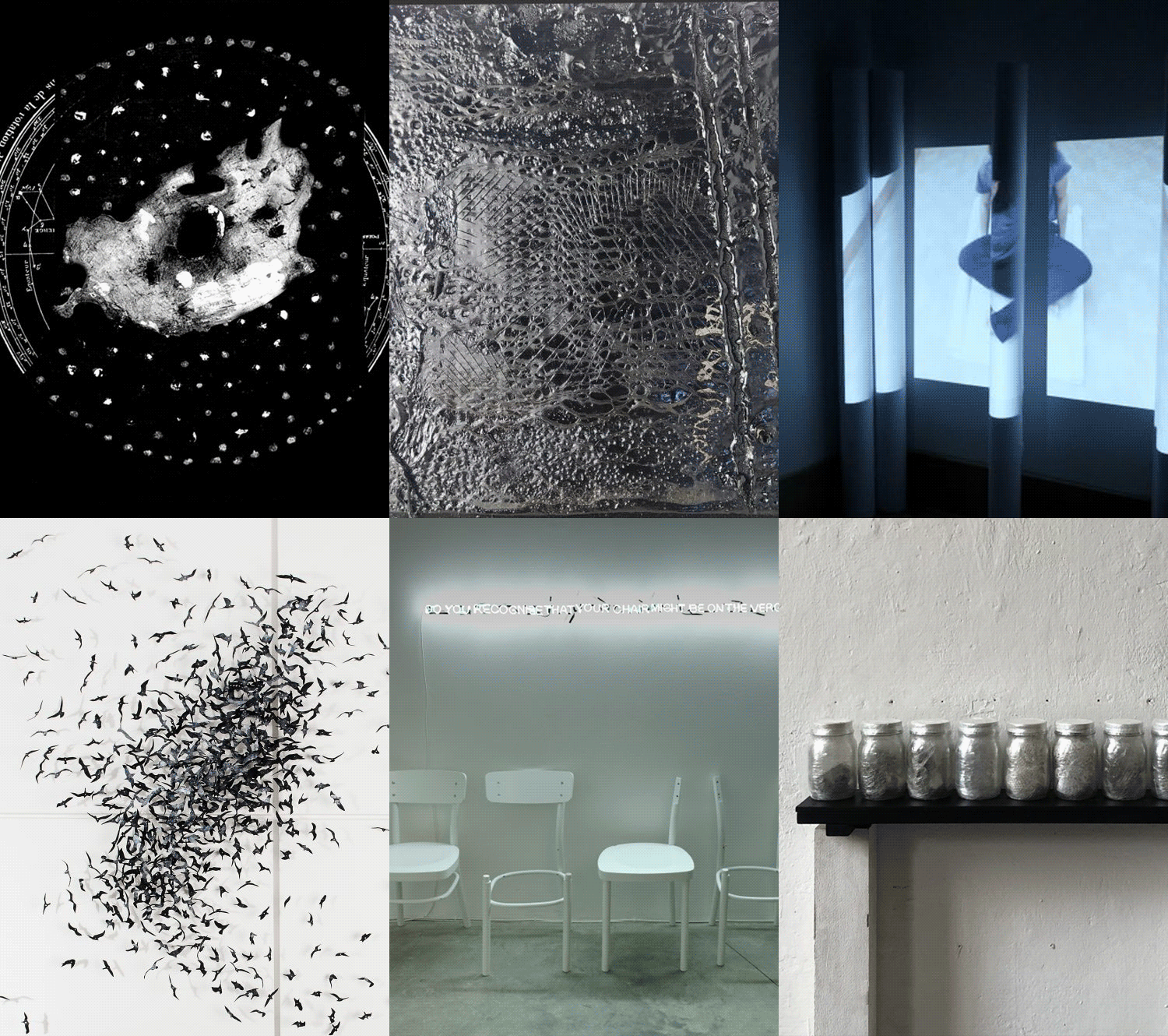
«My research stems from observing and listening to the landscape. One of my goals is to deepen the relationship between humans and nature by creating a perceptual imbalance, altering the perspective,» says Giovanni Chiamenti about his work. «The process consists of progressively distancing oneself from the object, removing most of the spatial coordinates while retaining only the traces necessary to capture the aura of the original element,» continues the artist born in Verona in 1992. After his studies at the Brera Academy and an Exchange Program at the Académie Royale des Beaux-Arts in Brussels, Chiamenti has exhibited at spazioSERRA in Milan and will soon be featured at the Galleria Giorgio Marrocco in Naples.

MIND-SCAPES
3rd Place: Edson Luli
Edson Luli was born in Shkodër, Albania, in 1989 and currently lives and works in Milan. He holds degrees in New Technologies for Art and in Cinema and Video from the Brera Academy of Fine Arts. In his practice, he uses various media—from printmaking to photography, from cinema to installation—seeking to redefine and hybridize them. Luli’s research lies at the intersection of ontology and epistemology, investigating the relationship established between the observer and the observed, and how they mutually influence and depend on each other. His works have been exhibited in international public and private spaces, including, recently, at Prometeo Gallery Ida Pisani and at Palazzo Reale in Milan for the Cairo Prize XX.

Including this
4th Place: Maziar Mokhtari
Born in Isfahan, Iran, in 1980, Maziar Mokhtari studied at the Academy of Fine Arts in Rome and currently works between Italy and Iran. For Mokhtari, art is an antidote to tear down every barrier—an art that lives and camouflages itself within boundaries and borders to fulfill its revolutionary capacity to cast off the veil and, thus, uncover. «My visual research stems from the discovery by a traveler who returns to visit his hometown (Esfahan) and observes the moment when the color yellow manifests itself on the walls,» explains the artist. «Memory is understood as a founding value of existence, the cultural and human foundation through which to undertake any journey.» His exhibitions include shows at Dino Morra Arte Contemporanea gallery in Naples and Emrooz Gallery in Isfahan, while a solo show is currently open at O’ Gallery in Tehran. His works have also been exhibited at the Archaeological Museum of Lampedusa, MACRO in Rome, and the Triennale di Milano.

Buddha & Pen
5th Place: tied Fabrice Bernasconi Borzì, Francesco Fossati, Alina Vergnano
Fabrice Bernasconi Borzì is an Italian-Swiss visual artist born in 1989 in Geneva, the city where he completed his studies and earned his degree at HEAD. For the past two years, he has lived and worked in Catania, where he completed his studies with a Master’s degree in Visual Arts from the Academy of Fine Arts. He realized that his true inspiration stemmed from Sicily, his homeland. Thus, he undertook a sort of reverse journey, moving from Northern to Southern Europe, feeling the need not to lose his original culture. This national and existential dualism, this double citizenship, with its inherent contradiction, lies at the foundation of the balanced conflict between forces that his work aims to express. As a further technical inspiration, he works as an exhibition designer and technical manager for international curators, galleries, and museums, such as for the Armenian Pavilion at the 56th Venice Biennale and the Fondazione Sandretto Re Baudengo. In May 2021, he will open a solo exhibition at Massimoligreggi gallery in Catania, while his works have been exhibited in Germany, Switzerland, Estonia, France, and Finland, in public and private venues.

Crossover
Born in 1985, Francesco Fossati is a visual artist and forager of wild and alimurgic plants. His research focuses on respect for nature and sustainability. Creating works with the lowest possible environmental impact, he has built eco-gardens, produced oil paints and pigments using natural substances, and employed social engagement practices and local labor for public art projects. He recently launched a sustainable art library at the Porto Museo di Tricase (LE) and participated in the exhibition “Solstice” curated by American artist Judy Chicago at the Turner Carroll Gallery in Santa Fe (NM) as part of the Create Art for Earth project launched by Hans Ulrich Obrist along with Judy Chicago and Jane Fonda. He supported the transition of the Institute of Contemporary Art in Los Angeles to become the first fully solar-powered museum, and in recent months launched a shared trial of self-produced natural oil paints.

Rombo-Dune [ortensia]

If This Relates To That
6th Place: Chiara Ventura
«I am intrigued by behaviors, especially automatic, involuntary, uncontrolled ones. I investigate the correspondences between physical and mental conditions, between movements and emotionality,» says Chiara Ventura describing her work. «I operate in uncomfortable, unprotected places—inside myself, outside myself. I investigate the ways of experiencing the surrounding reality, focusing on observational skills in daily, routine contexts; for this reason too, my gesture is often mimetic,» continues the artist, born in Verona on June 19, 1997, and currently at the Academy of Fine Arts in Verona. «In repetition I find the time for understanding, and in the gaze of the other the purpose of making art. My work is a continuous inquiry into empathy, the self, acoustics, gestures, the body, the space of thought, the gaze, and violence.» Among her most recent projects and exhibitions are a solo show at Spazio Cordis in Verona and group exhibitions at Baroque Gallery in Tehran and Bastione Sangallo in Fano. Ventura is also co-founder of two artistic collectives: Collettivo Plurale and menodi30caratteri.

Untitled 6
7th Place: Laura Fortin
Born in Padua on October 16, 1979, Laura Fortin lives and works in Turin. «My research investigates the feminine—body and mind. It is a relentless look at what women usually do not exhibit, out of convenience or imposed upbringing,» says the artist. «The unhappy central role, neurosis, alienation, the solitude of one’s role in almost two-dimensional, unwelcoming, detached spaces—prosceniums of an absolute mental dimension where a ruthless feminine, though not feminist, resistance takes place. These women are protagonists of flesh, even sagging flesh, or intentions distorted in their gazes, but within them lies a foundational wonder that saves them from superficial bourgeois decorum and suggests that within one’s own identity resides the sole possibility of redemption.» In 2019 she was a finalist for the Combat Prize in Livorno, and since 2018 she has been represented by Rizomi gallery in Parma and, since 2021, by Art base Gallery in Wiesbaden, Germany.

Pacific palisades
8th Place: tied Gregorio Samsa, Francesco Piva
Gregorio Samsa is an artistic duo that defines itself as a single artist. They have held solo exhibitions in Turin, Rome, and Milan. They use video, sculptures, fabric collages, embroidery, and furniture elements to create visual pathways constructed like a game of mirrors with a strong sense of ambivalence. Verisimilitude, a shadow zone between reality and paradox, is at the core of the artist’s reflection, structured through careful manipulation. Starting from footage found on the web, Gregorio Samsa alters real data, inserting their own works into a continuous interplay between inside and outside, reality and fiction. In every exhibition project, video becomes the place where reality merges with possibility, offering the viewer an alternative reality aimed at triggering new poetic interpretations. They have exhibited in various venues, including AlbumArte in Rome and the Museo Fattori in Livorno, as finalists for the Combat Prize in 2016 and 2020.

Memory Sediments – Portion of Red Studio
Francesco Piva lives and works in Venice, the city where he was born in 1991. In 2016, he graduated in New Technologies for Art from the Academy of Fine Arts in Venice. During his formative years, he experimented with various languages, creating photographic projects, videos, site-specific installations, and sound installations. Thus, he began investigating the urban landscape, the virtual and digital landscape of the web, and the technological tools of our time. He is currently dedicating himself to studying soundscapes and experimenting with various sound practices. In August 2020, he took part in the residency project In-Edita – Art Studios DEDALO, curated by Venice Galleries View at Forte Marghera (VE), following which he began collaborating with Marina Bastianello Gallery in Mestre (VE).

Mute
9th Place: Adonai Sebhatu
Born in 1986, Adonai Sebhatu lives and works in Bologna. Of Eritrean origin, he places his experience as a second-generation child of immigrants at the service of art, developing his own life story within his artistic research. It is space that inspires the artist—the environment and the elements found within it. Wood, metal, stone, and plastic are processed and blended into new shapes and figures, in enclosed or open spaces, adhering to the real or resorting to the virtual, in search of a welcoming new identity that neglects no element and develops new artistic perspectives. His production focuses on a blend of visual codes where traditional techniques alternate with the use and staging of found objects and electronic components, aiming for a new representation that finds a fruitful balance through the mediation between painting, drawing, sculpture, and installation. In 2019, he won the Coppa Luigi at the 11th edition of the Nocivelli Prize. He has exhibited at Palazzo Martinengo in Brescia, the Monumental Complex of Santa Sofia in Salerno, and the Galleria del Carbone in Nuremberg, among other venues.

The Migrants
10th Place: Ketra
Elena Pizzato, known artistically as Ketra, was born in Bassano del Grappa in 1979. Graduating with honors from the Academy of Fine Arts in Venice, she develops her research around the body and artificial modifications, experimenting with a wide range of materials and media. During an artist residency in the Netherlands, she explored the concepts of fetish and inorganic aesthetics, taking inspiration from Mario Perniola’s treatise, The Sex Appeal of the Inorganic. Ranging from bas-relief to sculpture, installation, and video, Ketra uncovers an underworld populated by dolls stripped of their reassuring crinolines and clad in latex, mirrors alluding to unconfessable secrets rather than Snow White’s stepmother, brass knuckles transformed into rocking horses, corsets imprisoned in PVC and studded frames, and crocheted potholders made by her 93-year-old grandmother bearing rebellious slogans. Dark fairy tales and contemporary reality intertwine with irony, revealing Ketra’s feminine and esoteric imprint.

WANDA VON DUNAJE