
work
Ti inseguo memoria
| category | Installation |
| subject | Abstract |
| tags | memoria, busta da lettera, tempo, ruggine, invio, spedizione, viaggio |
| base | 110 cm |
| height | 60 cm |
| depth | 0 cm |
| year | 1999 |
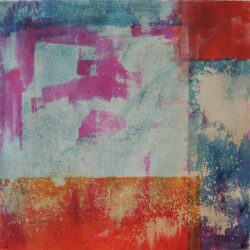
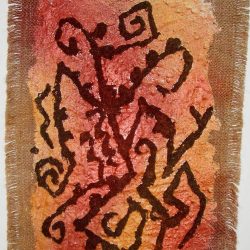
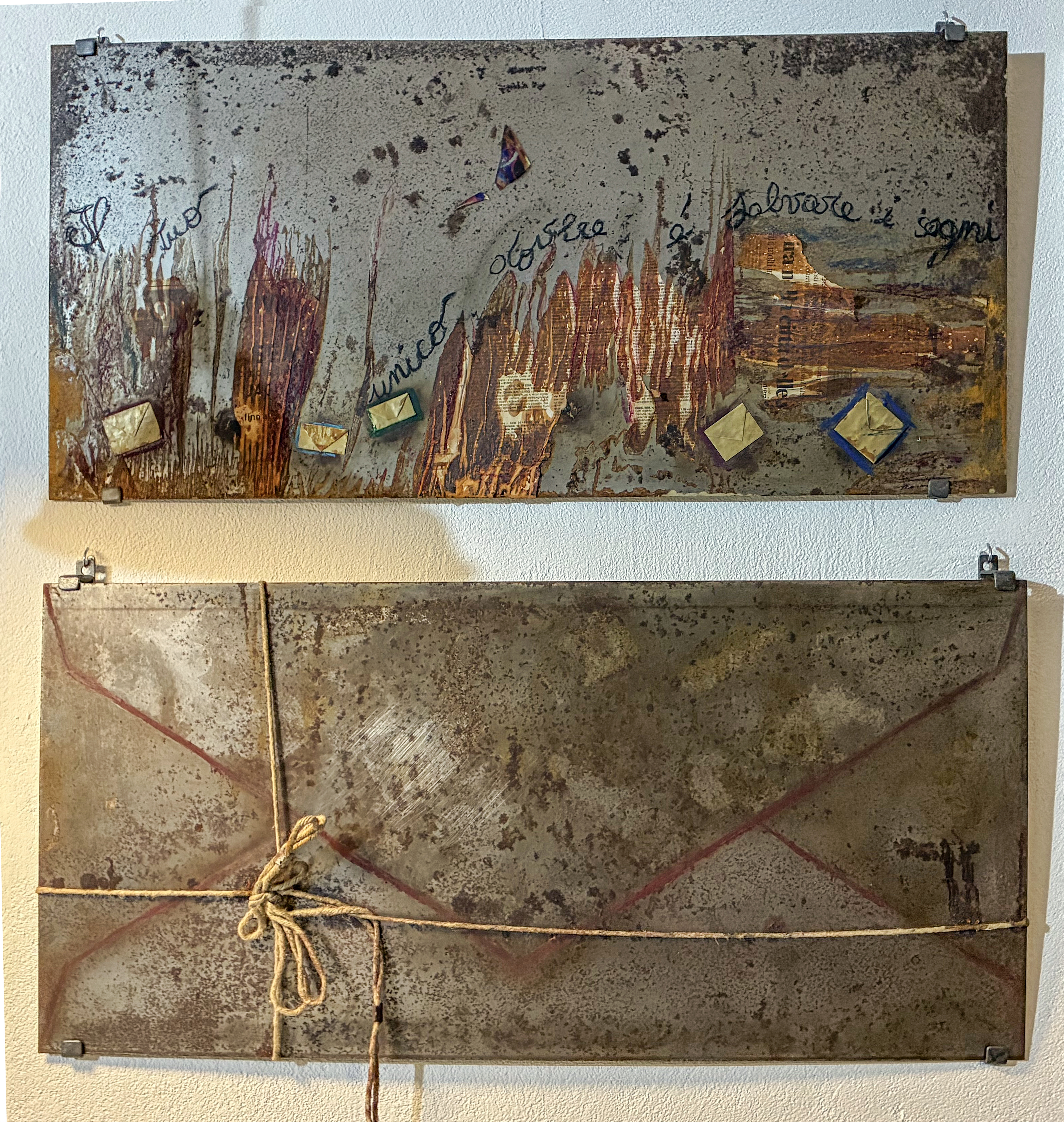
The work stems from the intuition of using the metal sheet as a metaphor for the letter: a thin sheet that, crossing lands and centuries, becomes a silent witness to joys and sorrows. Metal, a cold and seemingly inert material, replaces the fragility of paper, transforming communication into fossilized memory.
The oxidized surface becomes an archive of time. Writing, understood as the original seed of memory, flows like an engraved trace: memories fixed, layered, crystallized until frozen in oblivion. In an age dominated by technology and speed, the letter—slow, awaited, physical—is transformed into a relic, almost a commemorative plaque of a human gesture destined to disappear.
The metal sheet thus becomes an opaque mirror of identity: it does not reflect clearly, but returns a fragmented, corroded image, difficult to decipher. It is in the rust, the abrasions, the metallic dust that primordial signs emerge, visual archetypes that precede writing itself. They are ancestral traces that reaffirm the desire to recognize oneself, to recompose one's inner history.
The installation unfolds in two distinct yet complementary elements: a closed letter and its open envelope. The letter, sealed and marked with signs and stamps, preserves the mystery of its contents, embodying the intimate and secret dimension of memory. It is a message guarded, held back, perhaps unread. The closing becomes a symbolic act of protection but also of distance, of suspended time.
Next to it, the open envelope reveals its emptied wrapping, the act of opening as a gesture of revelation and, at the same time, of loss. If the letter represents the inner core, the envelope is the threshold: that which simultaneously protects and exposes. The opening suggests a passage—from secrecy to awareness, from silence to speech, from oblivion to rediscovered memory.
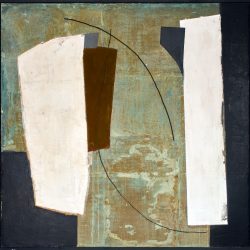
The metal "sheets" thus take the form of materialized letters: marked by folds, symbolic closures, ropes, and stamps that evoke distant expeditions. Messages without a precise addressee, sent to humanity and, at the same time, returned to the sender. Each element becomes a narrative fragment in which images, generated by rust and dust, aggregate into evocative figures, suggesting a story suspended between will and reality.
The artistic journey unfolds as an investigation of memory: a search for elementary and original images, the starting point of writing and consciousness, to embark on a fantastical journey toward the roots of identity. The closed letter and the open envelope are not just objects, but symbolic polarities: interiority and exposure, silence and revelation, a preserved past and a questioning present.
The oxidized surface becomes an archive of time. Writing, understood as the original seed of memory, flows like an engraved trace: memories fixed, layered, crystallized until frozen in oblivion. In an age dominated by technology and speed, the letter—slow, awaited, physical—is transformed into a relic, almost a commemorative plaque of a human gesture destined to disappear.
The metal sheet thus becomes an opaque mirror of identity: it does not reflect clearly, but returns a fragmented, corroded image, difficult to decipher. It is in the rust, the abrasions, the metallic dust that primordial signs emerge, visual archetypes that precede writing itself. They are ancestral traces that reaffirm the desire to recognize oneself, to recompose one's inner history.
The installation unfolds in two distinct yet complementary elements: a closed letter and its open envelope. The letter, sealed and marked with signs and stamps, preserves the mystery of its contents, embodying the intimate and secret dimension of memory. It is a message guarded, held back, perhaps unread. The closing becomes a symbolic act of protection but also of distance, of suspended time.
Next to it, the open envelope reveals its emptied wrapping, the act of opening as a gesture of revelation and, at the same time, of loss. If the letter represents the inner core, the envelope is the threshold: that which simultaneously protects and exposes. The opening suggests a passage—from secrecy to awareness, from silence to speech, from oblivion to rediscovered memory.
The metal "sheets" thus take the form of materialized letters: marked by folds, symbolic closures, ropes, and stamps that evoke distant expeditions. Messages without a precise addressee, sent to humanity and, at the same time, returned to the sender. Each element becomes a narrative fragment in which images, generated by rust and dust, aggregate into evocative figures, suggesting a story suspended between will and reality.
The artistic journey unfolds as an investigation of memory: a search for elementary and original images, the starting point of writing and consciousness, to embark on a fantastical journey toward the roots of identity. The closed letter and the open envelope are not just objects, but symbolic polarities: interiority and exposure, silence and revelation, a preserved past and a questioning present.