

work
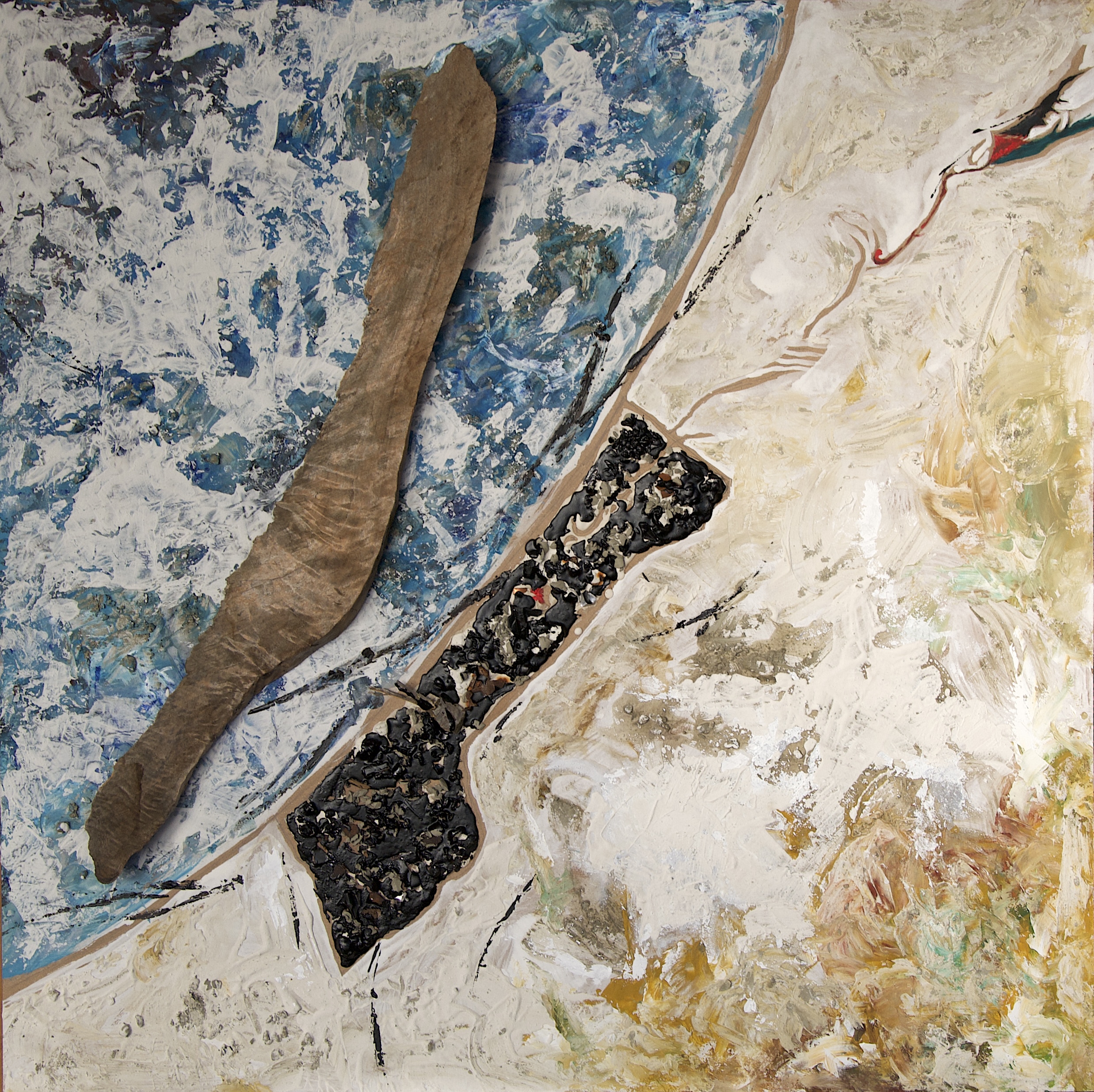
CICATRICE NERA – GAZA DILANIATA, SOSPESA, TRA MARE (CHIUSO) E DESERTO
| category | Painting |
| subject | Landscape, Political / Social |
| base | 100 cm |
| height | 100 cm |
| depth | 12 cm |
| year | 2025 |
Mixed media: acrylic, tar, wood, fragments of organic, metallic, and synthetic materials on MDF.
A stripe of tar deeply marks the work, like a wound carved into the flesh of the world. Gaza, reduced to a symbol and at the same time a living reality, emerges as a traversed body, caught between the blue of the sea and the blinding paleness of the sand. Material is the absolute protagonist: sand, bitumen, fragments, wood—all elements that give voice to what is too often silenced.
The artistic gesture here also becomes a political gesture. Pitch, a dense, dark, and viscous material, "that penetrates everything, like an engraved condemnation," is not just substance: it is a metaphor for oppression, for obscuring, for the erasure of a people, for a guilt that clings and cannot be washed away. A stripe of pitch between a stolen land and a sea that is visible but impassable, beautiful but forbidden. Another stripe, of rough, knotty wood, then crosses the pictorial space; A natural trace of life and redemption, but also a symbol of a border, a barrier: a closed sea, in fact, a symbol of siege. The Gaza Strip is thus treated not as a map, but as a subject of memory and denunciation: alive, resistant, irreducible.
In one corner, precariously balanced, the Palestinian flag appears. It is not the visual center but its beating heart: a detail that screams. An act of visual testimony, fragile and radical at the same time.
A stripe of tar deeply marks the work, like a wound carved into the flesh of the world. Gaza, reduced to a symbol and at the same time a living reality, emerges as a traversed body, caught between the blue of the sea and the blinding paleness of the sand. Material is the absolute protagonist: sand, bitumen, fragments, wood—all elements that give voice to what is too often silenced.
The artistic gesture here also becomes a political gesture. Pitch, a dense, dark, and viscous material, "that penetrates everything, like an engraved condemnation," is not just substance: it is a metaphor for oppression, for obscuring, for the erasure of a people, for a guilt that clings and cannot be washed away. A stripe of pitch between a stolen land and a sea that is visible but impassable, beautiful but forbidden. Another stripe, of rough, knotty wood, then crosses the pictorial space; A natural trace of life and redemption, but also a symbol of a border, a barrier: a closed sea, in fact, a symbol of siege. The Gaza Strip is thus treated not as a map, but as a subject of memory and denunciation: alive, resistant, irreducible.
In one corner, precariously balanced, the Palestinian flag appears. It is not the visual center but its beating heart: a detail that screams. An act of visual testimony, fragile and radical at the same time.