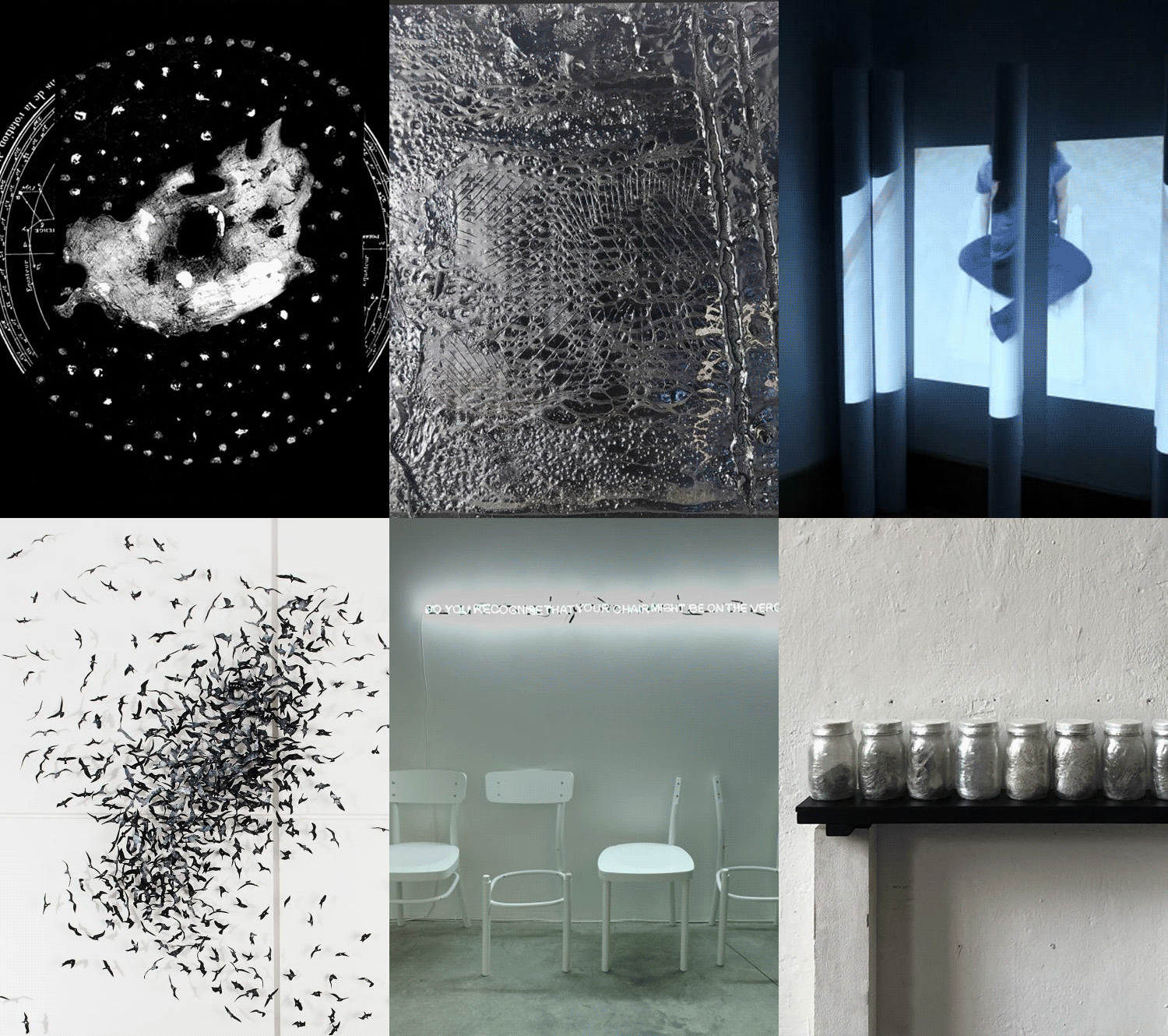

Edson Luli is the winner of exibart prize 2023
Among the over one thousand participants in this edition, Edson Luli, following a landslide vote, wins the third edition of the exibart prize. For the record, it is worth remembering that Edson has been present in the final ranking since the very first edition, having already placed third and fifth in previous rounds. The award founded by exibart continues its mission of establishing the best artists on the national scene.
The jury for this edition, composed of Elsa Barbieri (curator), Nicoletta Castellaneta (director of Accademia Aldo Galli Ied Network), Uros Gorgone (general manager of exibart), Marco Mattioli (Fondazione Archivio Afro), Simone Menegoi (artistic director of Arte Fiera Bologna), Ida Pisani (gallerist at Prometeo Gallery), Luca Staccioli (artist), Andrea Lesina and Paolo Ziotti (collectors), presents as usual the list of the top 10 positions:
1. Edson Luli
2. Greg Jager 2. Arianna Ellero
3. Mattia Sugamiele
4. Luisa Turuani 4. Jingge Dong
5. Francesca Piovesan
6. Elena Ketra 6. Stefan Milosavljevic
7. Bekim Hasaj
8. Plurale
9. Lisha Liang 9. Salvatore Mauro
10. Erika Godino 10. Fulvio Morella
Below are the profiles of all 15 artists.


Edson Luli
Through his practice, Luli invites viewers to participate in a process of exploration and observation, probing the boundaries of what it means to think and perceive in a complex and rapidly evolving world.
One of the central concerns of Luli’s work is the question of how we evaluate the inner lives of others. Through a variety of media—including printmaking, photography, video, and installation—Luli seeks to create new ways of representing and interacting with reality, inviting viewers to confront their own values and perceptions to build a space for exploration and deep questioning.


Greg Jager
Greg Jager’s research is articulated through interdisciplinary frameworks grounded in constant theoretical investigation, raising questions about contemporary society, its contradictions, and its heritage, with the goal of activating the participatory construction of new ecosystems through artistic experience.
His work is not bound to formal recognizability; instead, it is structured around project-based thinking that intersects graffiti art, installation, performance, painting, editorial projects, and collective dialogue, using a relational and anthropological approach to explore possible connections between different forms of intelligence and their collaboration.


Arianna Ellero
I am a wanderer, a researcher, and a free spirit. Through painting and performance, I explore the possibilities and potential of the human being; I investigate the concept of sound, seeking awareness and reconnection with what we are: Thought, Nature, Creation.
A journey shaped over time with a direct gaze toward painting in its essentiality, the dialogue with space through mark and color, the necessity of white on the canvas—always in search of a new language beyond the dialectic of figuration. Just as musical spaces exist in music, the white on the canvas represents for me the sound of the void—the silence that precedes the event.


Mattia Sugamiele
I am interested in the transformation of the image, which mutates until it disappears, often stripped of the system of signs it was able to evoke, creating a void in which technology finds its space.
My research explores the interaction between humans—along with their memories, actions, desires, and hopes—and the evolution of the technological sphere shaping our contemporary world.


Luisa Turuani
Luisa Turuani investigates human nature through the desires that people project onto objects. After completing her studies in sculpture at the Brera Academy of Fine Arts in 2017, she began experimenting with her first performative actions in urban spaces, interacting with the public—who were often unaware of being a fundamental part of the artworks. Born in the 1990s, at the threshold between the pre-digital era and hyperconnection, the artist conceives her works by merging physical materiality with the digital, giving life to constantly transforming pieces.


Jingge Dong
Jingge Dong’s works seem to uncover our consciousness between waking life and sleep, when a dream undermines reality. The present, fragments of memories, and fantasies are simultaneously ghostly and distinct. This duality marks a certain trend, one larger than the imagery language of a single artist.
The distinction between figurative and abstract painting is becoming increasingly irrelevant. Figures lose their outlines, transforming into spots of color—the elements of composition; abstraction borrows plasticity from biological forms, everyday objects, natural phenomena, and optical effects.


Francesca Piovesan
Francesca Piovesan was born in Aviano in 1981; she works between Aviano and Venice. After graduating in 2004 in Mural Painting Restoration from the UIA in Venice, she graduated in 2014 in Visual Arts from the Academy of Fine Arts in Venice. In 2015, she won the 3rd edition of the Cramum Prize, in 2018 she was selected for the BIAS Biennale in Palermo, and in 2021 she was chosen to represent Italy at the Glass Biennale (Bornholm Art Museum) in Denmark.


Elena Ketra
Elena attended the art academy in Venice searching for the words needed to write her alternative reality. Which isn’t even feminism as such—because even that story, that precise word, feels to her like an enclosure where someone else would like women confined: another Barbie. Because it isn’t about men and women, black and white, rich and poor. It is about equality, about equal opportunity. And every step in that direction is a collective step. It has to be. Otherwise, it would be nothing more than building another privilege—a new disparity.


Stefan Milosavljevic
My work is mainly based on the relationship between human needs and nature. I am interested in the forced mutation of natural elements in relation to human desires, and how these permanent changes are connected to politics, wealth, gender, social roles, and identity, where layers of history are determined by aesthetic trends. I am fascinated by abandoned everyday objects of design, decoration, and various utilities that were once constructed out of great desire and then left to their fate.
One of the main themes I address is death and the infinite time that stems from it.


Bekim Hasaj
My artistic research, by questioning the representation of content and setting aside the figurative, focuses on the fundamental and constituent elements of a pictorial work: colors, forms, gestures, space, and support. The process of ‘making’ plays a fundamental role in the procedure and creation of the work—how the material is treated, used, changed, and impressed into a space that becomes almost sculptural, guided by improvisation and intuition.


plurale
plurale is a collective form of presence in the world that manifests as an open ensemble. From June 2020 to March 2022, it exhibited under the name Collettivo Plurale, after which it no longer felt the need to present itself as an author with a first and last name, because plurale, before being an artistic collective, is a reaction, a way of thinking, and thus a way of acting. plurale stems from the need to feel part of the same environment-being; for this reason, it looks where division exists and attempts to mend it.


Lisha Liang
Liang’s practice focuses on social issues through an interdisciplinary approach blending performance, sculpture, interactive and active installations, video, photography, painting, and more. Through her work, the artist highlights the prejudices and imperfections of today’s complex society: the pressures faced by the public to conform to unattainable standards and the impossibility of a solid definition of an individual’s identity within their community.


Salvatore Mauro
For the best meaningful understanding of the work proposed by Salvatore Mauro, I would unhesitatingly cite certain forms of expression originating in the 1960s—particularly that type of object-based work with high technological content, as seen in the conceptual art of Joseph Kosuth, Dan Flavin, and Maurizio Nannucci, but with a process-oriented angle close to Merz and a neo-Futurist concept akin to Marco Lodola, a reference that identifies a Mediterranean linguistic root. However, there is also the hyper-modern transliteration of objects into a language that aims to become an assemblage of signs and learned communication in the style of the 2000s, relating the public and the artist’s interventions.
Domenico Scudero


Erika Godino
My artistic research is based on creating a strong visual impact on the viewer—creating a connection between work and human being. Transmitting through mark and color an emotional stimulus strong enough to disorient anyone standing before it. Distortion of reality through my unconscious. My theme is centered on the void—understood not as solitude and abandonment, but as the void that each of us should seek within ourselves.


Fulvio Morella
Fulvio Morella’s artistic research is the result of continuous exploration—both artistic and technical—into wooden matter and the interaction between wood and other materials. Over the years, the choice of material has increasingly become a question of content: matter becomes a concept for the artist, who in his works always combines the harmony of forms and colors with a concept that permeates the meaning of the piece beyond mere surface abstraction. Geometric shapes and unadorned curves are the distinguishing marks of his visual research.