

work
Paesaggio n°10
| category | Painting |
| subject | Architecture |
| base | 80 cm |
| height | 100 cm |
| depth | 4 cm |
| year | 2025 |
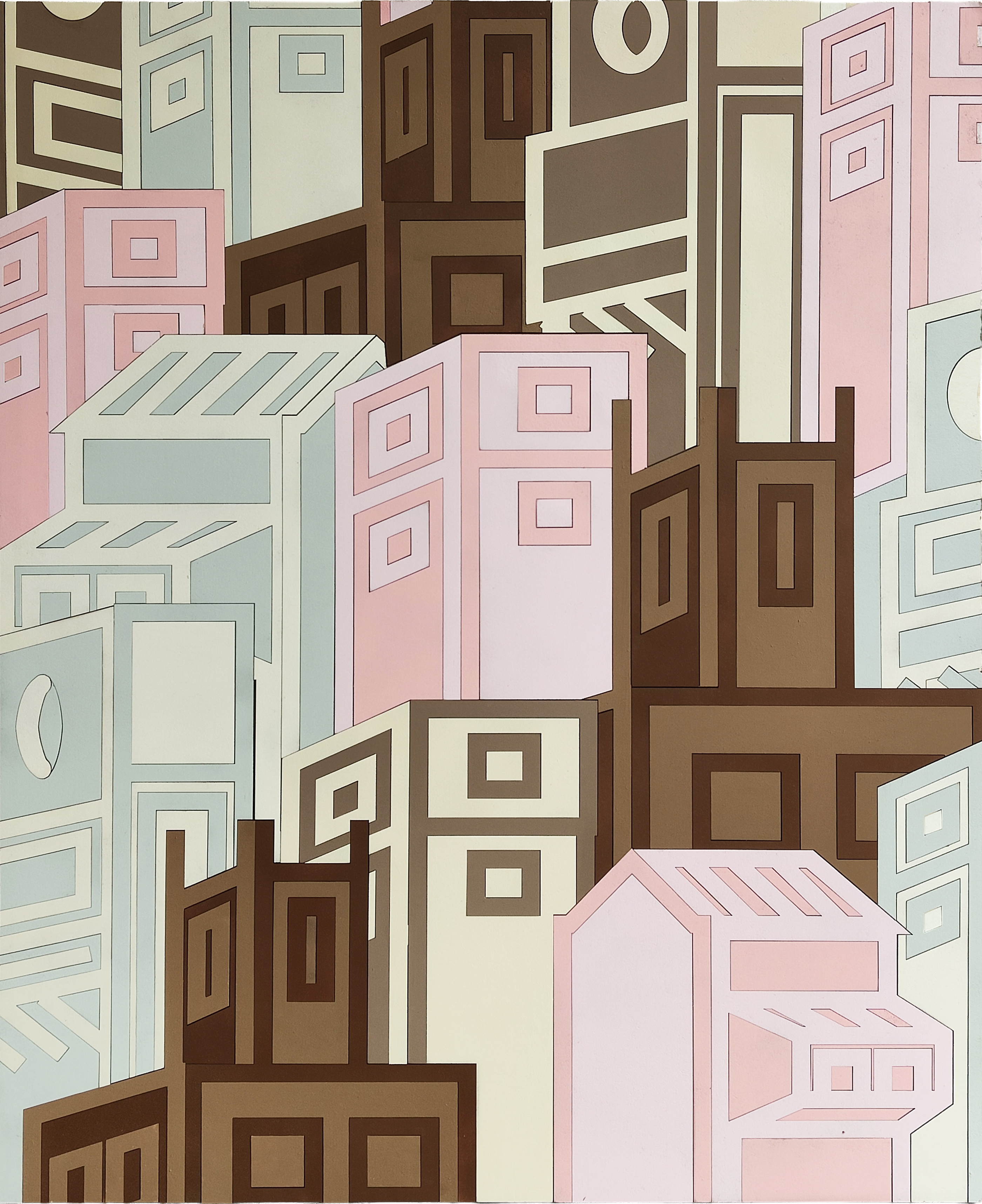
In this work, Giulio Patrizi turns his attention to the compact urban fabric of medieval towns. Built through a flat composition of colored wooden elements reminiscent of traditional wood inlay, the image unfolds as a dense arrangement of towers, facades, and architectural volumes that saturate the pictorial field.
The work draws a clear formal reference to fourteenth-century painting, particularly to the great fresco cycles of the Italian Trecento, where architecture functions not as realistic space but as a symbolic and narrative structure. Like in those painted cities that frame sacred and civic stories, the buildings here overlap and compress the visual field, generating a rhythmic and ordered surface.
"Patrizi reactivates the visual grammar of Trecento painting, transforming the medieval city into a contemporary image. Architecture loses its descriptive function and becomes a modular structure of forms, where memory, pattern, and abstraction converges into a timeless urban icon."
The work draws a clear formal reference to fourteenth-century painting, particularly to the great fresco cycles of the Italian Trecento, where architecture functions not as realistic space but as a symbolic and narrative structure. Like in those painted cities that frame sacred and civic stories, the buildings here overlap and compress the visual field, generating a rhythmic and ordered surface.
"Patrizi reactivates the visual grammar of Trecento painting, transforming the medieval city into a contemporary image. Architecture loses its descriptive function and becomes a modular structure of forms, where memory, pattern, and abstraction converges into a timeless urban icon."