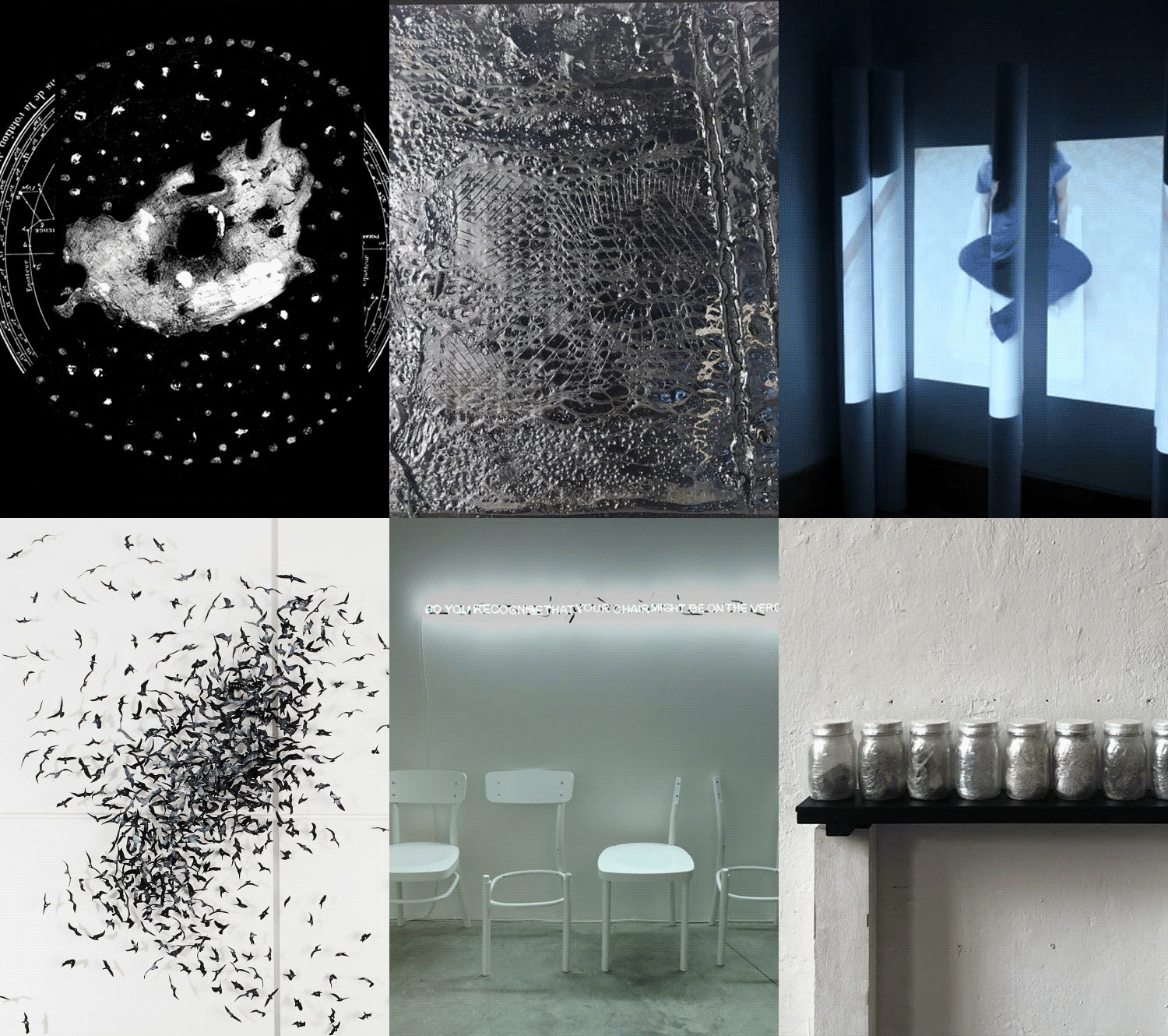

Elena Ketra is the winner of the fourth edition of the exibart prize
After a tight competition that saw the top 4 positions separated by very few points, mathematics has given its official verdict.
Below, as usual, is the ranking with the top 10 finalists and their profiles.
1. Elena Ketra
2. Valentina Gelain
3. Xinhan Yú
4. Plurale
5. Mattia Sugamiele
6. Fabrice Bernasconi Borzì
7. Erika Godino
8. Bekim Hasaj
9. Stefan Milosavljevic
10. Stefano Cescon

Elena Ketra
Elena Ketra is a visual artist graduated from the Academy of Fine Arts in Venice who lives and works between Treviso and Rome, whose research addresses social issues, above all female empowerment, social inclusion, and self-awareness. Her works, from “Girlpower”, a rocking brass knuckle for ferocious little girls, to the “Serialmirrors” series, fetish mirrors reflecting stories of female killers, up to “Utereyes”, the uterus with eyes that does not suffer but chooses, are all united by a clear inclination towards rebellion against assigned roles and gender stereotypes. She recently presented the digital performance Sologamy as an international preview in Rome, addressing the social phenomenon of sologamy, through which for the first time anyone can marry themselves online. She has exhibited in numerous solo and group exhibitions, including at the Museo Madre in Naples, the MAM in Mantua, the Silesian Museum in Katowice (PL), and the Stichting Artes in Amsterdam. In 2022, she won the exibart prize in the section dedicated to gender equality and social inclusion, was a finalist for the Combat Prize and the exibart prize, and in 2024 was shortlisted as a finalist for the international Arte Laguna Prize with her manifesto-artwork “Utereyes”. Her works are part of public and private collections, including that of the Fondazione Solares delle Arti. National newspapers and magazines have covered her research, including Corriere della Sera, La Repubblica, Rai, Radio Deejay, Vanity Fair, Donna Moderna, Grazia, Io Donna. This year, the artist was invited by the European Center for Investigative Psychology and Criminology (Cepic) as a lecturer in the training course of excellence, “CONsenso”, funded by the Ministry of Justice – Department for Justice Affairs, to address the theme “Art as therapy”. In June, her solo exhibition is scheduled at the Mucciaccia Gallery Project in Rome.

Valentina Gelain
Valentina Gelain was born in Feltre in 1992 and currently lives and works in Ostrobothnia, Finland.
Through subjective experience and introspection, Gelain investigates issues related to human existentialism, drawing directly from the mental and emotional, symbolic and dreamlike spheres.
Thanks to a plural opening of perceptions, various research themes are explored—such as inner conflicts, mental landscapes, and redemption—through a synergy between form and content, image and intention.
Her analysis is based on the practice of (intra-)confrontation, openness, and dialogue, seeking to overturn barriers, reach out to, and touch the other through intimate reflections and genuine experiences. This gives space to invisible parts of our being that are often still rejected with indifference and misunderstanding, recalling unfettered resources of thought and awareness of the other starting from ourselves.
Stretching a thread between consciousness and unconsciousness, vision and figuration, the balance swings between introspective investigation and the search for an empathetic equilibrium. Accepting discomfort for true change in a voluntary, active path leads to various catharses of being and, consequently, to how we can (co-)exist in reality.
An interdisciplinary artist, Gelain explores subjects and figurations through different languages and media that help convey her vision of the artwork at its best.

Xinhan Yú
Xinhan Yú (Nanjing, China, 1996)
Earned a Master’s degree in Visual Arts Painting from the two-year specialization program at the Academy of Fine Arts in Bologna in 2022. He currently resides in Bologna.
In Yú’s interventions, there is always a taste for spectacle, humor, and the grotesque, and his provocations resonate with Chinese youth; he conceals irony and metaphors within his imaginary narrative, playfully yet rawly flirting with the issues of new-era Chinese society. The desire for revenge, the need to act, and the ambition to circumvent an oppressive system are the motivations behind the works of XinHan Yú, a Chinese artist who uses various media as tools for social critique—a way to exhume a memory, both personal and collective, of a reality that needs to be brought to light. His current practice revolves around power structures and institutions of violence.

plurale
plurale is a collective form of presence in the world that manifests as an open ensemble. From June 2020 to March 2022, it exhibited under the name Collettivo Plurale, after which it no longer felt the need to present itself as an author with a first and last name, because plurale, before being an artistic collective, is a reaction, a way of thinking, and thus a way of acting. plurale stems from the need to feel part of the same environment-being; for this reason, it looks where division exists and attempts to mend it.
plurale is a concept.
Founded in 2020, it presents itself as an osmotic artistic collective whose core motivators are Leonardo Avesani (Verona, 1997) and Chiara Ventura (Verona, 1997). By exploring an empathetic form of existence through artistic practice, plurale works on the flaws it finds in everyday life, paying special attention to language, forms of violence, and how the generation to which its members belong (Generation Z) positions itself in the world.
In 2022, it published Gesto empatico (Empathetic Gesture), a poetic declaration asserting its being-in-the-world, advocating empathetic action as the only viable mean today to restore equal rights and dignity to beings and things. plurale has initiated a transfeminist practice in an attempt to dismantle a heteronormative view of the body and decolonize desire, observing sexuality and pleasure as political spaces.

Mattia Sugamiele
My research focuses on installation and the use of various media, including painting, sculpture, new technologies, and video. The starting point is the theory of the philosopher Floridi, which focuses on the current human condition, divided between the digital and real worlds, which in a poetic metaphor is visualized as the habitat of mangroves living in balance between fresh and salt water.
In the digital realm, forms and objects tend to dematerialize, merging to become impalpable; my works experience the paradox of a physical, soft, and hybrid rendering, not purely virtual. The heterogeneity of my installations and works becomes a space for questioning the relationship between humanity and technology, a dialogue of creation, adversity, and continuous transformation.
I am interested in the transformation of the image, which mutates until it disappears, often stripped of the system of signs it was able to evoke, creating a void in which technology finds its space.
My research explores the interaction between humans—along with their memories, actions, desires, and hopes—and the evolution of the technological sphere shaping our contemporary world.

Fabrice Bernasconi Borzì
Fabrice Bernasconi Borzì is an Italian-Swiss artist, born in Geneva in 1989, where he completed his studies graduating in Construction from HEAD in 2016. Since 2018, he lives and works in Catania, where he earned a second-level academic degree in Visual Arts from the Academy of Fine Arts.
For the artist, this relocation represents a sort of reverse journey compared to the one taken by many of his peers: in moving from Northern to Southern Europe, he attempts to rediscover a cultural alterity peculiar to places of origin, functional to his artistic practice. This national and existential dualism, this double citizenship, with its inherent contradiction, lies at the foundation of the balanced conflict between forces that his work aims to express.
The formal elements he employs are most often simple, minimal, or depotentiated, as if to subvert the ‘accustomed’ through the use of a paradoxical and at times provocative language of Dadaist origin, which does not shy away from citationism and recycling. The intent is clear, as it develops a series of questions on the very meaning of ‘making’, on its implicit conceptual assumptions, as well as on how all this is interpreted within the current art system. From these premises stems a reflection on human beings and their alienation from existence, in a dichotomy that politically inherits the tradition of conflict between productive and social forces, against hegemonic and capitalist powers.
His appears to be a kind of philosophy of idiocy, whose linguistic structure—often precarious forms and extemporaneous assemblages—is the result of an oxymoronic ‘discipline of the provisional’ that at times recalls a certain intellectual intent of Situationist détournement viewed from the processual perspective of a rigorous and methodical behaviorism. A contradiction in terms that leads him to work, with stubborn discipline, on complex concepts such as loss, precariousness, and resilience, hidden under the expressive device of a poorly concealed irony. Under these conditions, nihilism and history, defeatism and teleology become one, bringing into being an active and catalyzing form of resistance. This is a conjunction of philosophy and revolt, of belief, subversion, and belonging. Politics and poetry in the raw gesture of keeping one’s balance despite the evidence of facts.
Fabrice Bernasconi Borzì considers himself a “sponge and a thief of ideas, but one who works hard to truly be who he is.”

Erika Godino
Erika Godino was born in 1993 in Lamezia Terme. She currently lives and works in Milan. She earned her second-level degree from the School of Painting at the Academy of Fine Arts in Reggio Calabria in 2018 with top honors. She is currently pursuing a second degree in Printmaking at the Brera Academy of Fine Arts. In 2022, she completed an internship at Luca Pancrazzi studio.
The void, chaos, the unconscious, and inner stillness are the themes present in Erika Godino’s artistic research. For the artist, the canvas and medium represent a sort of film reel onto which she transcribes the emotions and moods experienced during specific periods of her life. Fragments of her dream journey, which she explores daily through nature, her surroundings, encounters, human beings, and vicissitudes. The void is understood not as solitude and abandonment, but as the void that every individual should seek within themselves. Color and mark propagate across the large support, attempting to create a strong visual impact on the observer. The viewer must find themselves invaded and immersed, confusing and merging with the artwork, rediscovering their Self and losing themselves. Erika G. seeks to distort reality through her unconscious: she paints “her” reality. An intimate dialogue that no longer remains private, but allows everyone else to enter her world, to contemplate and disorient the human being.
She floats within her visionary space.

Bekim Hasaj
Although my research approach is now interdisciplinary, open, and ready to experiment outside my primary field of study, I remain strongly tied to the study of color, mark, and painting.
My artistic research, by questioning the representation of content and setting aside the figurative, focuses on the fundamental and constituent elements of a pictorial work: colors, forms, gestures, space, and support. The process of ‘making’ plays a fundamental role in the procedure and creation of the work—how the material is treated, used, changed, and impressed into a space that becomes almost sculptural, guided by improvisation and intuition. It is an approach that finds similarities with ‘Process Art’, though without defining itself as such.
In a broader vision, I aim to understand the genesis of artistic creation in order to apply and experiment with it across different categories, disciplines, media, or languages. For this reason, I have found myself experimenting with video art, installation, sculpture, performance, and so forth. I am interested in the multidimensions these media can reach, always striving to do so from my starting point: painting. Reflections on coexistence—visible and invisible, known and unknown—often emerge in my research, which I view as a parable of my artistic creation process.
My artistic path was marked by drawing and painting from an early age, continuing through ‘classical’ academic training during art high school and the early university years, until I opened up to the multi-languages of contemporary art encountered and experienced at a more mature age. Indeed, looking back, a figurative expression tied to painting techniques is noticeable, where the human figure and self-portrait are recurring themes in my production—themes linked to a deep existential feeling interconnected with the human being, which is still present in me and my research today. During the final years at the Brera Academy of Fine Arts, a break occurred with the ‘figurative’ and representation as such, opening me toward a greater consciousness of color and form—dynamics that are noticeable both in composition and material use, exteriorizing into more plastic forms that begin a new dialogue with the space in which they are created or installed. Moving beyond the ‘classical’ two-dimensional canvas (to paint) marked a point of no return for me, opening dimensions that go beyond one’s own field of study and emphasizing once again a total rejection of illustrative representation in relation to the support and its presumed form and flatness. The same happens to content, which is questioned and reconceptualized through the process of ‘making’, rather than through mere figurative representation within the artwork.
Currently, I am seeking a closer dialogue between art object and surrounding environment, between color, space, and concept, in search of a new artistic balance.

Stefan Milosavljevic
My work is mainly based on the relationship between human needs and nature. I am interested in the forced mutation of natural elements in relation to human desires, and how these permanent changes are connected to politics, wealth, gender, social roles, and identity, where layers of history are determined by aesthetic trends. I am fascinated by abandoned everyday objects of design, decoration, and various utilities that were once constructed out of great desire and then left to their fate.
One of the main themes I address is death and the infinite time that stems from it.

Stefano Cescon
My artistic research has led me to reflect on the role of nature and time: from the symbolic material of this practice (a mixture of pure waxes) to the choice of natural pigments, earths, or minerals.
This aspect allows the entire body of work to be receptive and absorb the “seisms” coming from external conditions during execution, such as the place and environment in which I operate.
This meta-pictorial action then transforms into a personal reinterpretation of these suggestions, taking on the typical traits of a daily ritual—a deposition of thoughts overlapping in suspended time.
What I am interested in expressing is a delicate balance between poetics and material; the latter becomes the spokesperson for a history sedimented over time, like the pages of a great book containing both the orogeny of a mountain range and a pictorial memory that constitutes our identity.
The result is a painting composed of shades of color, an element that is inherently difficult to communicate by definition. As in music, when we try to define it, we run into the limits of our language, because color in nature is a transition—it is fundamentally comparable to time, as it does not act in the here and now.
This “flow” of my practice, like a rhythm suggested by the tides of the material, makes each work sequential to the next: thus revealing an organic narrative (both metaphorically and in fact) in which each piece ideally represents a cell of a broader, potentially infinite system.
The rules of difference and repetition inherent to nature are common to and at the core of my research: it is interesting to observe how a process based on these simple rules produces a complex “organism”, resulting from the variety of nuances caused by the replication of a pattern.
Each experience carries with it the fruits of the previous one, thus following an infinite scale.