



Xinhan Yú
(Nanking, CHN)
Xinhan Yú received his Master’s degree in Visual Arts from the Academy of Fine Arts in Bologna in 2022. He currently lives and works in Bologna.
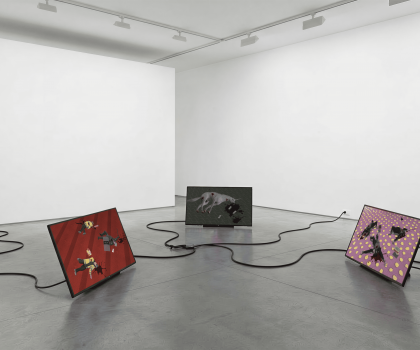
Yú works with video, installation, sculpture, and image-based media. His practice examines power structures and institutional violence, treating violence not as an isolated event but as an embedded systemic logic. Through technological, symbolic, and routinized mechanisms, his works investigate how power shapes subjectivity, memory, and behavior. Rough textures, humor, and bold forms of expression recur throughout his practice, alongside childhood imagery, public authority, internet culture, and video game systems.
His research begins with the ordinary visual forms through which systems of authority become familiar: uniforms, toys, police objects, public symbols, game mechanics, children’s spaces, family images, and low-resolution digital materials. These forms often appear harmless, functional, or playful. In Yú’s work, however, they become unstable carriers of discipline, memory, and control.
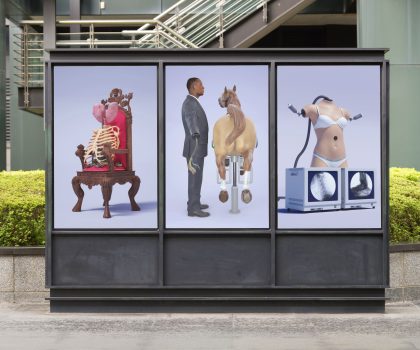
Rather than treating violence as a visible rupture, Yú approaches it as a condition that can be built into routine, language, entertainment, and the circulation of images. A toy may behave like a surveillance device. A game mechanic may become a model of obedience. A child’s body may reveal the early training of authority. A censored or politically charged image may return indirectly as a shape, color, object, or gesture.
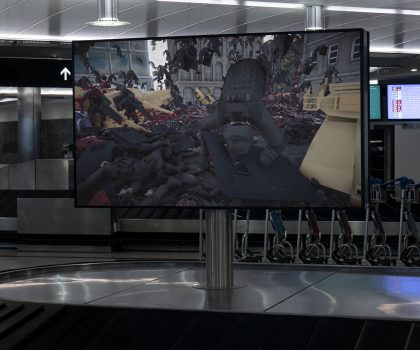
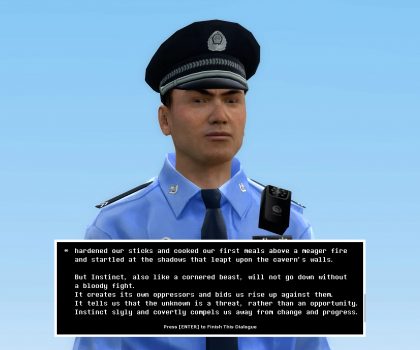
Game engines are important to Yú’s practice not because they offer a virtual escape, but because they expose the structure of rules. NPC dialogue, scripted movement, loot drops, loops, death states, and simulated environments become ways of thinking about how behavior is organized. Within these systems, action is never entirely free. An underlying logic predetermines time, value, movement, attention, and consequence. What can move, what can be read, what can be collected, and what must remain trapped are decided before the scene unfolds.
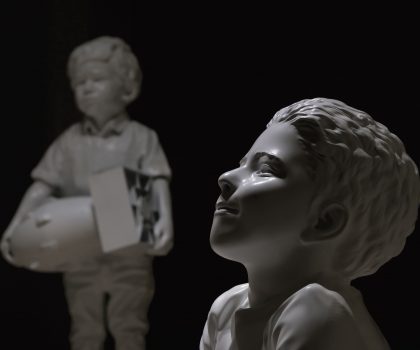
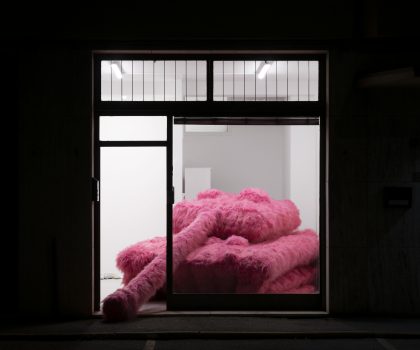
Childhood appears throughout Yú’s practice as an unstable political and emotional field. Playgrounds, toys, plush surfaces, cartoon figures, and child bodies are placed near weapons, uniforms, commands, and forms of public order. These combinations do not simply produce shock. They point to how discipline can begin before it is recognized as such. Innocence becomes difficult to separate from training; play becomes difficult to separate from control.
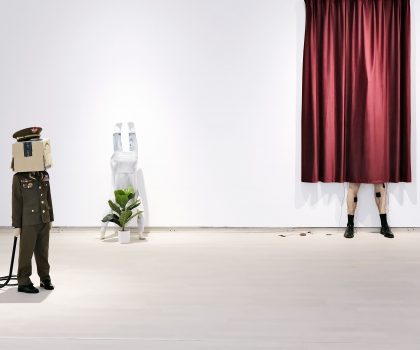
Childhood is not treated as a lost paradise, but as a site where family policy, collective memory, fear, fantasy, and institutional expectation can take soft, comic, or decorative forms. Yú also frequently works with public symbols after they have already been damaged, copied, emptied, or displaced. Police hats, tanks, uniforms, mascots, animal figures, and official-looking objects are removed from stable contexts and returned as props, toys, digital assets, or broken icons.
Their authority remains recognizable, but it no longer appears secure. This instability allows the works to examine how symbols continue to act even after they become absurd. The same logic extends to digital images. Low-resolution textures, rendering glitches, compressed surfaces, and awkward game-engine effects are not treated as failures to be corrected. They become part of the work’s material language.
(Nanking, CHN)
Xinhan Yú received his Master’s degree in Visual Arts from the Academy of Fine Arts in Bologna in 2022. He currently lives and works in Bologna.
Yú works with video, installation, sculpture, and image-based media. His practice examines power structures and institutional violence, treating violence not as an isolated event but as an embedded systemic logic. Through technological, symbolic, and routinized mechanisms, his works investigate how power shapes subjectivity, memory, and behavior. Rough textures, humor, and bold forms of expression recur throughout his practice, alongside childhood imagery, public authority, internet culture, and video game systems.
His research begins with the ordinary visual forms through which systems of authority become familiar: uniforms, toys, police objects, public symbols, game mechanics, children’s spaces, family images, and low-resolution digital materials. These forms often appear harmless, functional, or playful. In Yú’s work, however, they become unstable carriers of discipline, memory, and control.
Rather than treating violence as a visible rupture, Yú approaches it as a condition that can be built into routine, language, entertainment, and the circulation of images. A toy may behave like a surveillance device. A game mechanic may become a model of obedience. A child’s body may reveal the early training of authority. A censored or politically charged image may return indirectly as a shape, color, object, or gesture.
Game engines are important to Yú’s practice not because they offer a virtual escape, but because they expose the structure of rules. NPC dialogue, scripted movement, loot drops, loops, death states, and simulated environments become ways of thinking about how behavior is organized. Within these systems, action is never entirely free. An underlying logic predetermines time, value, movement, attention, and consequence. What can move, what can be read, what can be collected, and what must remain trapped are decided before the scene unfolds.
Childhood appears throughout Yú’s practice as an unstable political and emotional field. Playgrounds, toys, plush surfaces, cartoon figures, and child bodies are placed near weapons, uniforms, commands, and forms of public order. These combinations do not simply produce shock. They point to how discipline can begin before it is recognized as such. Innocence becomes difficult to separate from training; play becomes difficult to separate from control.
Childhood is not treated as a lost paradise, but as a site where family policy, collective memory, fear, fantasy, and institutional expectation can take soft, comic, or decorative forms. Yú also frequently works with public symbols after they have already been damaged, copied, emptied, or displaced. Police hats, tanks, uniforms, mascots, animal figures, and official-looking objects are removed from stable contexts and returned as props, toys, digital assets, or broken icons.
Their authority remains recognizable, but it no longer appears secure. This instability allows the works to examine how symbols continue to act even after they become absurd. The same logic extends to digital images. Low-resolution textures, rendering glitches, compressed surfaces, and awkward game-engine effects are not treated as failures to be corrected. They become part of the work’s material language.